
Question and Answering System: Classical, Neural, & RAG
A team usually decides it needs a question and answering system after the same support failure happens for the fifth time. A user asks a plain question like “Can I change my plan after invoicing?” and gets a search results page, a generic chatbot answer, or a hallucinated policy that sounds confident and wrong. Everyone in the room knows the raw content exists somewhere. The product still fails because finding text isn't the same as answering a question.
That gap is where most demos collapse in production. A chatbot can look impressive on a staging dataset and still break once real users ask ambiguous, cross-document, policy-sensitive questions. The hard part isn't getting a model to say something plausible. The hard part is building a system that retrieves the right evidence, stays within latency targets, degrades safely, and gives your team enough visibility to debug failures without guessing.
A good question and answering system is less like a chat widget and more like a disciplined pipeline. It has to understand intent, fetch relevant context, decide whether it has enough evidence, and answer in a form your users can trust. That sounds straightforward until you add private data, changing documentation, cost ceilings, and product owners who expect answers to be fast every time.
Table of Contents
- Beyond Simple Search Boxes
- The Evolution of Answering Machines
- Anatomy of a Modern QA System
- Choosing Your Architectural Pattern
- Implementation The Hard Parts
- Evaluation Deployment and Observability
- Conclusion Future-Proofing Your QA System
Beyond Simple Search Boxes
A product manager often sees the problem first. Support tickets keep linking to the same help center article, but users still ask the question. They aren't failing to locate text. They're failing to convert scattered information into a direct answer that fits their situation.
That's why a search box and a question and answering system solve different jobs. Search returns candidates. QA commits to an answer. The moment your product starts committing, engineering inherits a harder responsibility. You now need answer grounding, fallback behavior, relevance controls, and a way to say “I don't know” without wrecking the user experience.
Consider a common SaaS scenario. Your docs say one thing, your pricing page says another, and an internal operations note adds an exception for enterprise customers. A keyword search may surface all three. A weak chatbot may blend them into a smooth but incorrect paragraph. A production QA system has to retrieve the right pieces, preserve the exception, and avoid inventing policy.
A working demo proves the model can speak. A production system proves it can refuse, cite, and recover.
Teams new to QA usually overinvest in the model and underinvest in the pipeline. They spend days tuning a system prompt and almost no time on document preparation, chunk boundaries, metadata filters, or query logging. Then they wonder why answers drift. In practice, poor retrieval poisons even a strong model.
The discipline exists for a reason. Modern QA in natural language processing and information retrieval is about responding to natural language questions with natural language answers by determining context, extracting relevant information from large datasets, and presenting it concisely, as described in IBM's overview of question answering. That framing matters because it pushes teams away from “chatbot theater” and toward system design.
If you're building your first feature, the useful mental model is simple. Treat QA as a chain of decisions under constraints. Every stage can help or hurt the final answer. Every shortcut shows up later as latency spikes, hallucinations, or support escalations.
The Evolution of Answering Machines
From structured facts to language understanding
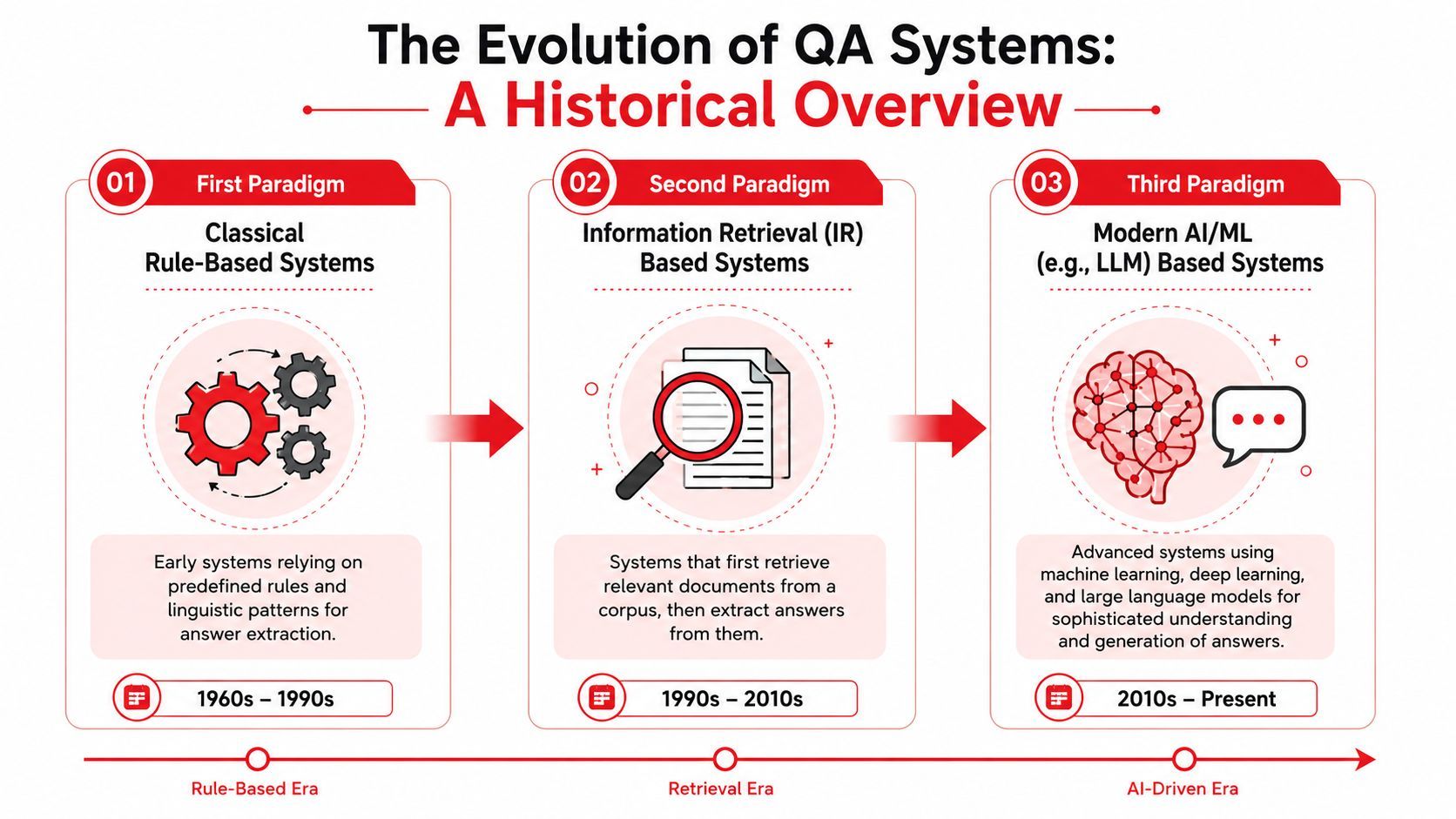
Question answering didn't start with large language models. The earliest systems appeared in the early 1960s, and two of the best known early examples were BASEBALL and LUNAR, which answered factoid questions by using underlying database or knowledge systems and treating queries as search requests over structured data, according to Lucidworks' history of QA systems. That design sounds primitive now, but it established the core idea that a machine could accept natural language input and return a precise answer.
Those classical systems were narrow and brittle. They worked when the domain was constrained, the schema was stable, and the question style matched what the system expected. They failed when users phrased things differently or asked beyond the covered domain. For internal enterprise workflows, though, that pattern is still relevant. If your data is highly structured and your answers must be deterministic, a classical approach can outperform a flashy generative stack.
The next big shift came from neural models built for extractive QA. These systems didn't invent answers. They identified spans from documents that likely answered the question. Models in the BERT family made this pattern practical for many teams because they improved language understanding without requiring hand-built rules for every question type. The trade-off was obvious. Extractive systems were grounded, but they were awkward when users needed synthesis across multiple passages.
RAG changed the operating model again. A retrieval-augmented generation pipeline combines retrieval over your documents with a generative model that writes the final answer. This is why RAG became the default pattern for private knowledge assistants, support bots, internal copilots, and policy assistants. It gives teams a way to use a model's language ability without forcing them to retrain it on every document change.
Practical rule: pick the least powerful architecture that reliably answers your users' real questions. More generation isn't automatically better.
Comparison of QA system approaches
The historical arc matters because teams still make the same mistake in reverse. They assume the newest stack replaces all earlier ideas. It doesn't. A strong question and answering system often mixes them. Structured filters from classical systems, extractive checks from neural QA, and RAG for answer synthesis can coexist in one product.
Anatomy of a Modern QA System
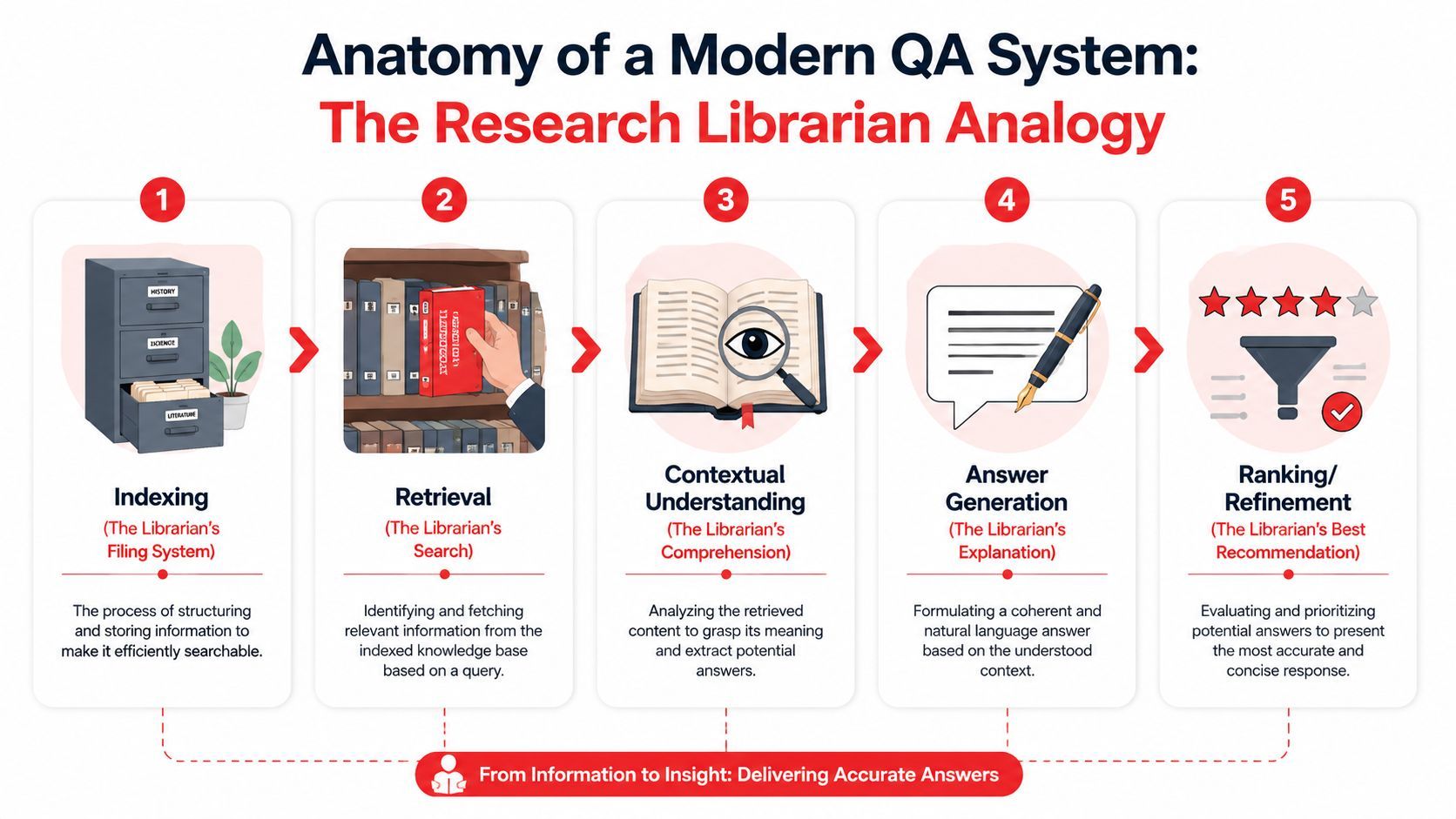
The easiest way to understand a modern QA pipeline is to think of a very good research librarian. The librarian doesn't memorize every page. They organize the collection, find relevant material quickly, read the best parts carefully, and then answer in plain language.
That's close to how modern production systems work. In information retrieval based QA, the system typically follows a three-stage process of question processing, passage retrieval and ranking, and answer extraction, as described in IBM's explanation of QA architecture. In practice, most production systems expand that into more explicit components because each stage needs separate tuning and monitoring.
Indexing starts the whole game
Indexing is where many teams set the stage for future bugs. You ingest source documents, split them into chunks, normalize formatting, attach metadata, and store representations that your retriever can search. If you chunk badly, everything downstream suffers.
A few practical patterns work well:
- Chunk by meaning, not only by length. A policy exception should stay attached to the policy it modifies. Splitting at arbitrary token windows often separates the answer from its qualifier.
- Preserve metadata early. Product area, document type, region, language, version, and visibility level all become retrieval filters later.
- Clean duplicated content. Repeated docs across changelogs, help centers, and internal wikis create contradictory evidence and unstable answers.
If the source of truth is weak, no prompt will save the output.
Retrieval and ranking decide answer quality
Retrieval is the librarian walking to the right shelf. Ranking is deciding which books go on the desk first. Teams often merge these concepts, but they fail differently and should be debugged separately.
A retriever usually starts broad. It finds candidate passages from a vector index, keyword engine, or hybrid search stack. Then a ranker narrows the set. In many systems, adding a reranker gives a larger quality improvement than changing the generator model, because the generator can only work with what it sees.
There are several healthy retrieval habits:
- Use hybrid retrieval when language is messy. Policy names, SKU identifiers, and legal clauses often benefit from keyword signals plus semantic retrieval.
- Apply metadata filters aggressively. If a user is asking about EU billing, don't retrieve US tax documents unless you want accidental contradictions.
- Log the misses. A wrong answer is often a retrieval failure wearing a generation mask.
Most bad answers start earlier than teams think. The model usually reveals a retrieval problem rather than creating the original one.
The reader or generator should be the last mile
After ranking, the system needs a reader. In extractive systems, the reader pulls the likely answer span. In generative systems, the reader is usually an LLM that synthesizes a response from the retrieved context.
Teams frequently overfocus. Yes, answer style matters. Yes, output formatting matters. But the generator should be treated as the last mile, not the whole stack. A strong reader can still fail if the top passages are stale, incomplete, or contradictory.
An effective answer generation layer usually includes:
- A grounded instruction. Tell the model to answer from provided context and to abstain when evidence is insufficient.
- A citation or evidence policy. Even if users never see raw citations, your internal trace should preserve which chunks supported the answer.
- A refusal path. “I can't verify that from the available documents” is often better product behavior than a polished guess.
- Post-processing checks. Validate schema, strip unsupported claims, and enforce product or compliance wording where needed.
Modern extractive QA systems are often described through three components, a Retriever, a Database, and a Reader, in IBM's overview of contemporary QA systems. That's a useful simplification. In production, additional control points are frequently inserted around those parts because real products need gating, analytics, fallback flows, and access controls.
Choosing Your Architectural Pattern
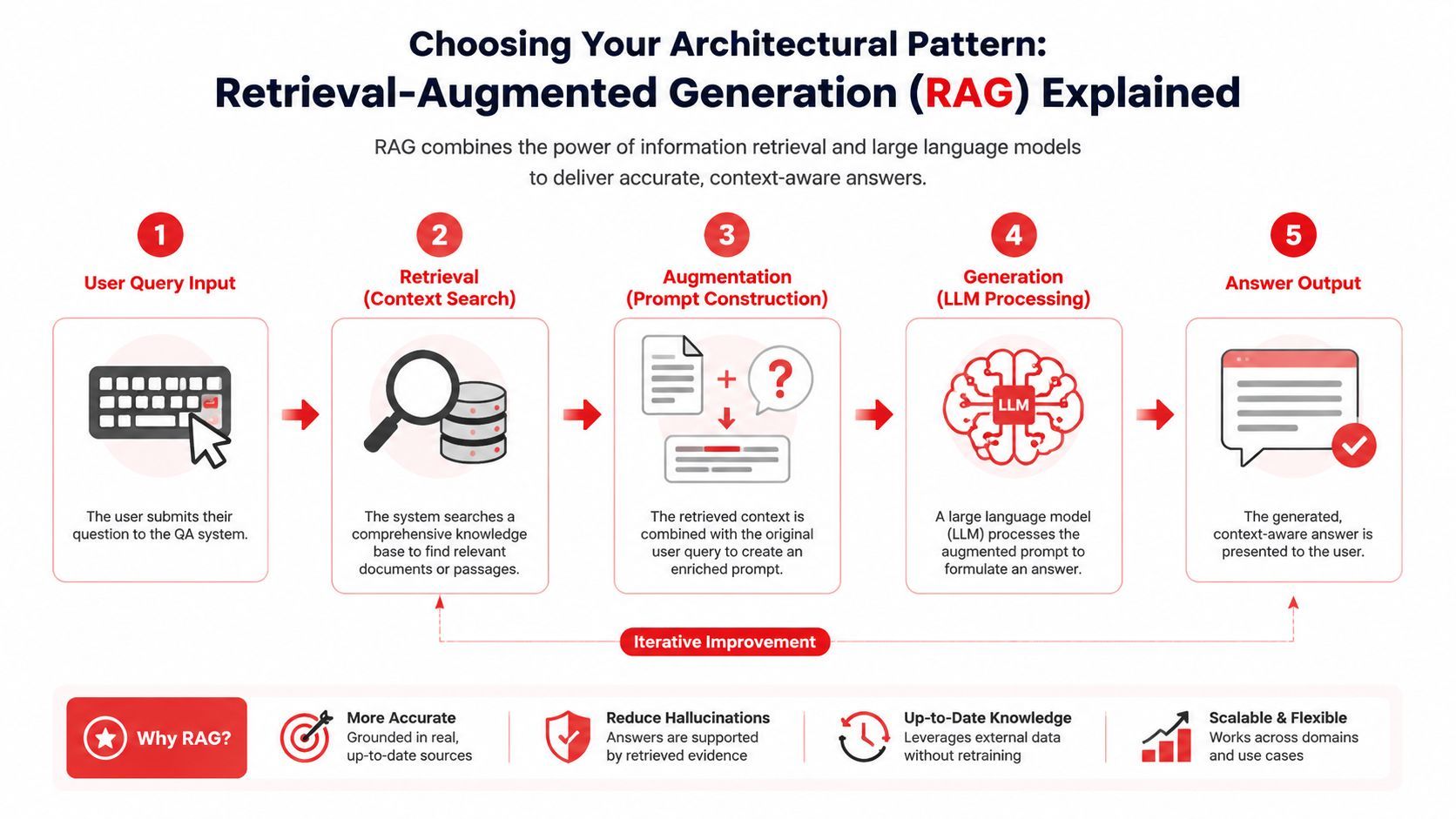
When building on private documents, RAG emerges as the most practical compromise. You don't need to fine-tune a model every time your docs change, and you don't need to trust the base model's pretraining to know your internal policies. But “use RAG” is too vague to guide implementation. You need to choose which version of RAG you're willing to operate.
Where naive RAG works
Naive RAG is a clean starting point. A user asks a question. The system embeds the query, retrieves a few chunks, drops them into a prompt, and asks an LLM to answer. If your data is tidy and your user questions map closely to document language, this can be enough for an internal tool or a first release.
Naive RAG works best when:
- The corpus is narrow. A single product manual, one help center, or a curated policy set is manageable.
- Questions are straightforward. “How do I reset MFA?” is easier than “What changed for enterprise billing exceptions after the last policy update?”
- You can tolerate manual cleanup. Early-stage teams often patch bad answers by adjusting chunking, metadata, and prompts.
It stops working when the corpus gets noisy. Once your system has duplicate docs, overlapping versions, fragmented policies, or cross-functional content, naive retrieval starts surfacing conflicting evidence. Then the generator gets blamed for ambiguity it didn't create.
What advanced RAG changes
Advanced RAG doesn't mean adding every research trick. It means adding control points where production failures happen.
A few upgrades pay off repeatedly:
- Query transformation before retrieval. Rewrite shorthand user input into a fuller retrieval query. “invoice reversal EU” may need expansion into billing, region, and account status language.
- Multi-step retrieval. Pull a broader candidate set first, then rerank with a stronger model or heuristic layer.
- Context compression after retrieval. Don't send every chunk to the generator. Select the passages that carry the answer and its constraints.
- Answer validation after generation. Check whether the final answer is supported by retrieved evidence and conforms to product rules.
This pattern matters because a question and answering system isn't a single inference call. It's an orchestration problem. Each added stage increases operational complexity, but each stage also gives you a place to measure and improve failure modes that would otherwise remain opaque.
If your team can't explain why a chunk was retrieved, why it was ranked highly, and why the model answered from it, you don't have a controllable system yet.
How to choose storage and retrieval infrastructure
The vector database debate usually starts too early. Teams compare Pinecone, Weaviate, Postgres extensions, managed cloud search, and custom hybrid stacks before they know their retrieval patterns. That's backwards.
Choose based on operational needs first:
For many teams, the right first move is boring. Start with infrastructure your team can operate confidently. If your developers already understand managed search and need shipping speed, that often beats an exotic retrieval stack with more knobs than you'll use. Retrieval quality usually improves faster from better chunking, metadata, and reranking than from a dramatic database migration.
Implementation The Hard Parts
Architecture diagrams hide the expensive decisions. Production QA systems fail under constraints, not in idealized flows. The practical challenge is balancing answer quality, response time, and operating cost without losing control of the user experience.
Latency quality and cost pull against each other
In real customer service benchmarks, there's a documented trade-off between latency and hallucination. State-of-the-art work on OlaBench reports that optimizing for sub-100ms latency can increase hallucination probability by 15 to 20% because the system retrieves less context, as described in the OlaBench benchmark paper. That aligns with what teams run into in production. Fast systems often become shallow systems.
The temptation is obvious. Trim retrieved context, skip reranking, reduce tool calls, and use a smaller model. Latency improves immediately. So does the chance that the model answers from partial evidence.
A healthier way to frame the trade-off is by request class:
- Fast path queries can use lighter retrieval and cheaper generation because the answer space is narrow.
- Ambiguous or policy-sensitive queries deserve more retrieval depth, stronger ranking, and stricter answer checks.
- High-risk requests should sometimes route to refusal or human review instead of forcing a model answer.
If every query gets the same architecture, you usually overpay on easy questions and under-serve the hard ones.
Prompting matters less than teams think
Prompting still matters, but not in the way most product teams assume. A stronger prompt won't compensate for irrelevant context. It won't resolve contradictory documents. It won't fix bad chunk boundaries.
The prompt's real job in QA is narrower:
- Define the answer contract.
- Tell the model how to use context.
- Specify what to do when evidence is missing.
- Shape response format for the product surface.
Good QA prompts are usually disciplined and plain. They instruct the model to rely on supplied material, avoid unsupported claims, and state uncertainty when needed. Long, theatrical system prompts often add style and very little control.
Model routing is usually worth it
One of the best production upgrades is model routing. Don't send every request to the largest model. Route based on difficulty, user tier, required format, risk level, and whether retrieval found strong evidence.
A practical routing policy might look like this:
This approach cuts wasted spend and improves consistency because you stop asking one model to be equally good at every task. The downside is complexity. Routing decisions themselves need logs, tests, and rollback paths.
Teams often ask which model is best. The better question is which model should answer which class of question.
The same logic applies to fallback behavior. If retrieval fails, you can ask a general model to answer anyway, but that usually converts a search miss into a hallucination. In production, the right fallback is often a narrower one: ask a clarifying question, return top documents, or decline to answer.
Evaluation Deployment and Observability
A question and answering system becomes manageable only when you can measure each part independently. End-to-end thumbs-up metrics are useful, but they rarely tell you where to fix the system. A bad answer can come from poor retrieval, stale content, weak ranking, an overcompressed prompt, a formatting bug, or the generator itself.
Evaluate retrieval and generation separately
Start by splitting the system into two scorecards.
For retrieval, inspect whether the right documents and passages appear near the top for known questions. Useful retrieval metrics are qualitative if you haven't built a formal evaluation set yet. Engineers can review whether the answer-bearing chunk appears, whether the system pulled contradictory versions, and whether metadata filters behaved correctly.
For generation, judge different questions than retrieval answers. Ask:
- Was the answer supported by retrieved context?
- Did it answer the user's actual question?
- Did it preserve caveats and exceptions?
- Did it abstain when the evidence was weak?
This split matters because retrieval and generation regress differently. A model change can make responses sound better while grounding gets worse. A retrieval tweak can improve evidence while answer tone becomes too terse. Without separate evaluation, those shifts hide inside a single pass rate.
Ship changes like software not like prompts
Prompt changes, model swaps, chunking updates, and retrieval configuration changes should all be versioned. If a release degrades answer quality, you need to know exactly what changed and roll it back quickly.
A safe deployment process usually includes:
- Versioned prompts and routing rules
- Staged rollout by traffic slice or user cohort
- Shadow testing on real queries before broad release
- A rollback path for retrieval config, not just model choice
This discipline feels heavy until the first time a harmless prompt edit causes the model to stop refusing unsupported questions. Then it feels basic.
Here's the kind of interface teams need once they're operating at scale:
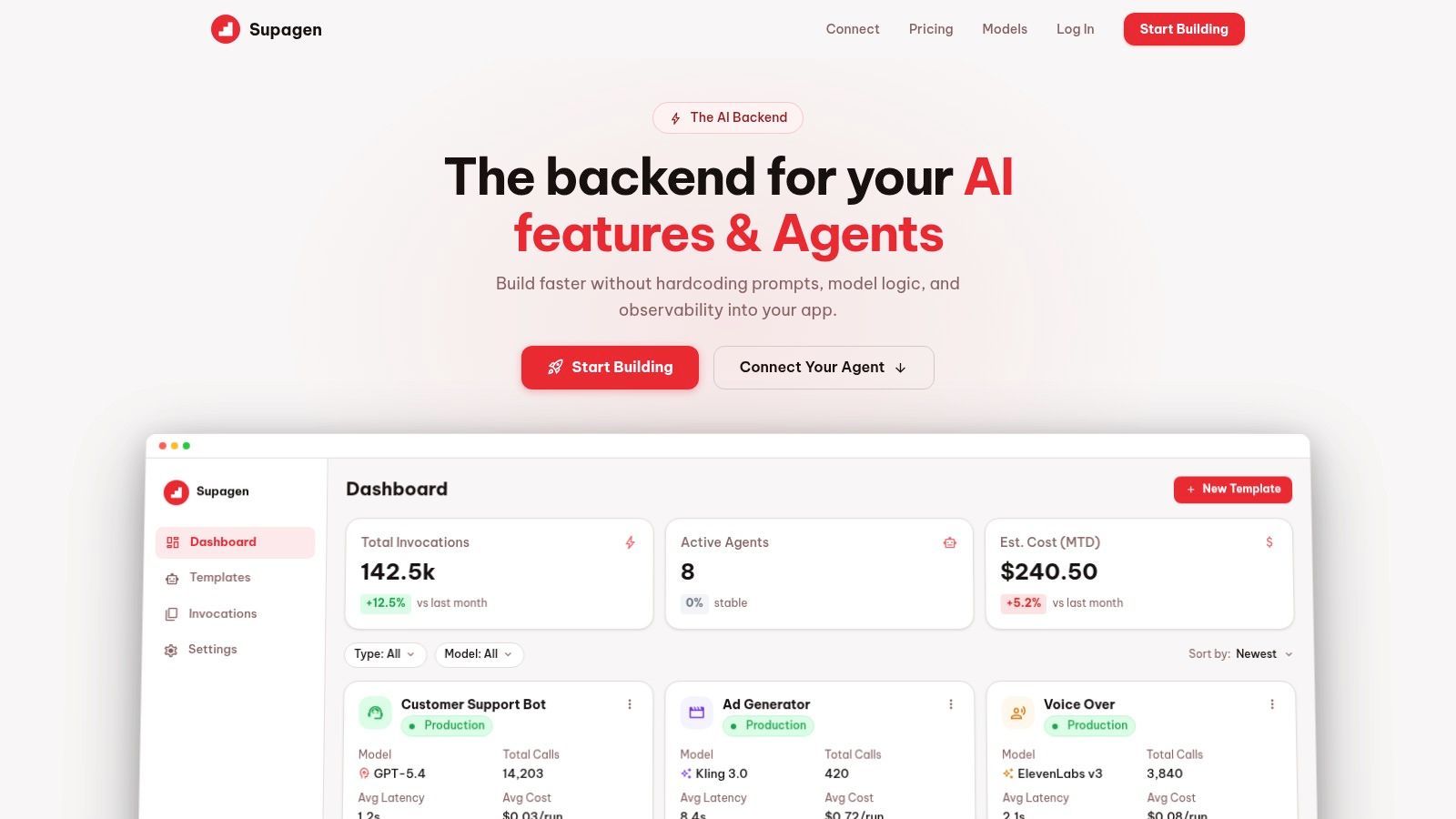
Observability is your debugging surface
If you don't log the full path from query to answer, debugging becomes folklore. People argue about whether “the model is bad” because nobody can inspect the trace.
Capture at least these fields for every request:
- User input and normalized query
- Retrieved chunks and their metadata
- Ranking order
- Prompt version and model choice
- Output text
- Latency for each stage
- Token usage and cost
- Fallbacks, refusals, and validation results
This isn't just for engineers. Product teams need it to understand which questions users ask, where they drop off, and which failure types repeat. Cost visibility also matters. QA systems can look cheap in isolation and become expensive once retrieval, reranking, guardrails, and retries all stack together.
Your benchmark can hide bias
A common approach prioritizes accuracy and overlooks representativeness. That's dangerous. Research on QA and reading comprehension benchmarks reports that half of the 30 most popular benchmarks fail to disclose annotator demographics or recruitment criteria, and all fail to report gender, age, or ethnicity, as discussed in this analysis of social bias transparency in QA benchmarking. If your evaluation data lacks representation transparency, a high score can still mask systematic failures for real users.
That has practical implications:
- Test across user phrasing styles. Formal and non-native phrasing can produce very different retrieval behavior.
- Review domain-specific ambiguity. Occupation, geography, religion, and other identity-linked contexts can trigger skewed answers.
- Don't confuse benchmark fit with product readiness. Your users are not a benchmark.
Conclusion Future-Proofing Your QA System
The teams that ship reliable QA features don't treat them like a single-model problem. They treat them like a production system with retrieval, ranking, generation, validation, deployment discipline, and observability. That mindset is what separates a polished demo from a feature users trust.
The architecture will keep evolving, but the core engineering lessons won't. Keep the knowledge base clean. Make retrieval inspectable. Use generation for synthesis, not for guessing. Route requests by difficulty instead of pushing every query through the same expensive path. Instrument the whole trace so failures become debuggable.
What will matter next
The scope of question answering is widening. Modern QA systems already support text, image, video, and audio experiences in production settings, as noted earlier in IBM's architectural framing of contemporary systems. That means future products won't just answer from documents. They'll answer from screenshots, meeting clips, support calls, and mixed media workflows.
Trust becomes more important as the domain gets riskier. In medicine especially, one unresolved challenge is trustworthy open-domain QA. Recent evaluation work notes that research focused on this area remains fragmented even though healthcare LLM work already emphasizes truthfulness, safety, and fairness, according to this review of trustworthy open-domain medical QA. That's a warning sign for every product team, even outside healthcare. If your system answers in a high-stakes context, “mostly good” isn't a sufficient standard.
The durable principle
A future-proof question and answering system isn't the one with the most advanced model. It's the one your team can understand, measure, and improve under real traffic. Build for evidence, not just eloquence. Build for rollback, not just launch. Build for refusal, not just fluency.
That's how QA becomes a dependable product capability instead of a recurring support incident.
Supagen helps teams put those production practices in place without hardcoding prompts, routing, or observability into the app itself. If you're building a question and answering system and want a faster path to versioned prompts, multi-model routing, logs, latency and cost tracking, take a look at Supagen.