
What Are Open Model Calls? A Production Guide
A team ships its first AI feature with one model behind one API key. For a sprint or two, that feels efficient. Then the production tickets start. Support sees timeouts cluster around peak traffic. Finance asks why a low-value workflow is hitting the same expensive model as a high-stakes one. An upstream provider has an incident, and suddenly your product does too. Prompt changes that should have been a config update now wait on a deploy window.
That pattern is common because single-model integrations are easy to start and hard to grow. The failure mode is not model quality. It is operations. Once AI sits on a user path, model selection becomes a systems problem involving latency budgets, fallback policy, version control, and request-level cost visibility.
That is what I mean by open model calls. Model access sits behind a control layer that can choose models deliberately, switch providers without rewriting product logic, and record what happened on every request. More model choice helps only if the application can route that choice safely and explain the result later.
The hard part is not finding open models. The hard part is running several of them in production without turning your stack into a pile of special cases.
Table of Contents
- Introduction Beyond the Single Model Trap
- What Exactly Are Open Model Calls
- Comparing Open vs Closed Model Architectures
- Key Production Patterns for Routing and Fallbacks
- Best Practices for Management and Observability
- A Practical Implementation Workflow
- Conclusion The Future Is Composable AI
Introduction Beyond the Single Model Trap
A team ships its first AI feature with one model and gets good results fast. Six months later, that same choice is driving a support bot, a document pipeline, an internal copilot, and a content workflow with very different latency and cost limits. The architecture did not break. It just stopped fitting the job.
That is the single model trap.
It usually starts as a reasonable engineering shortcut. One SDK is easier to integrate. One provider is easier to approve. One prompt format is easier to test. Early on, that simplicity is real.
The problems show up after the product surface grows. A retrieval-heavy support flow can tolerate more latency if the answer quality is stable. An inline writing assistant cannot. A batch extraction job should be priced very differently from a user-facing chat request. If all of them hit the same model with the same defaults, the team loses control of cost, response time, and output consistency.
Practical rule: if every request in your system goes to the same model by default, you are probably overpaying for some paths and under-serving others.
Open model calls solve that production problem. The point is not just access to open-source models. The point is keeping the inference path open so requests can be routed across multiple models, providers, and fallback options based on policy. Model choice moves out of product code and into an operational layer where it can be changed without rewriting the application.
That flexibility comes with work. More model options mean more decisions about routing, version pinning, failure handling, evaluation, and spend controls. Teams feel this before they name it. They see a surprise bill, a latency spike in one region, or a regression after a provider updates a model alias.
The pain usually sounds like this:
- "Why is this low-value task hitting the expensive model?"
- "Why did p95 latency jump after we rolled out in Europe?"
- "Why did outputs change when nobody touched the prompt?"
- "Why can't we tell whether the issue came from the provider, the router, or our prompt version?"
Those are operations questions. Prompt quality matters, but prompt quality alone does not run a multi-model system.
A better way to frame the problem is simple. Your application should ask for an outcome under clear constraints. The production layer should decide how to satisfy that request, log what happened, and fall back safely when a provider fails or a model drifts.
That sounds heavier than it is. The first useful version is usually small: one routing rule, one fallback path, one prompt registry, and logs detailed enough to explain a bad output after the fact. That is often enough to get out of the single model trap and start running AI features like production systems instead of demos.
What Exactly Are Open Model Calls
The working definition
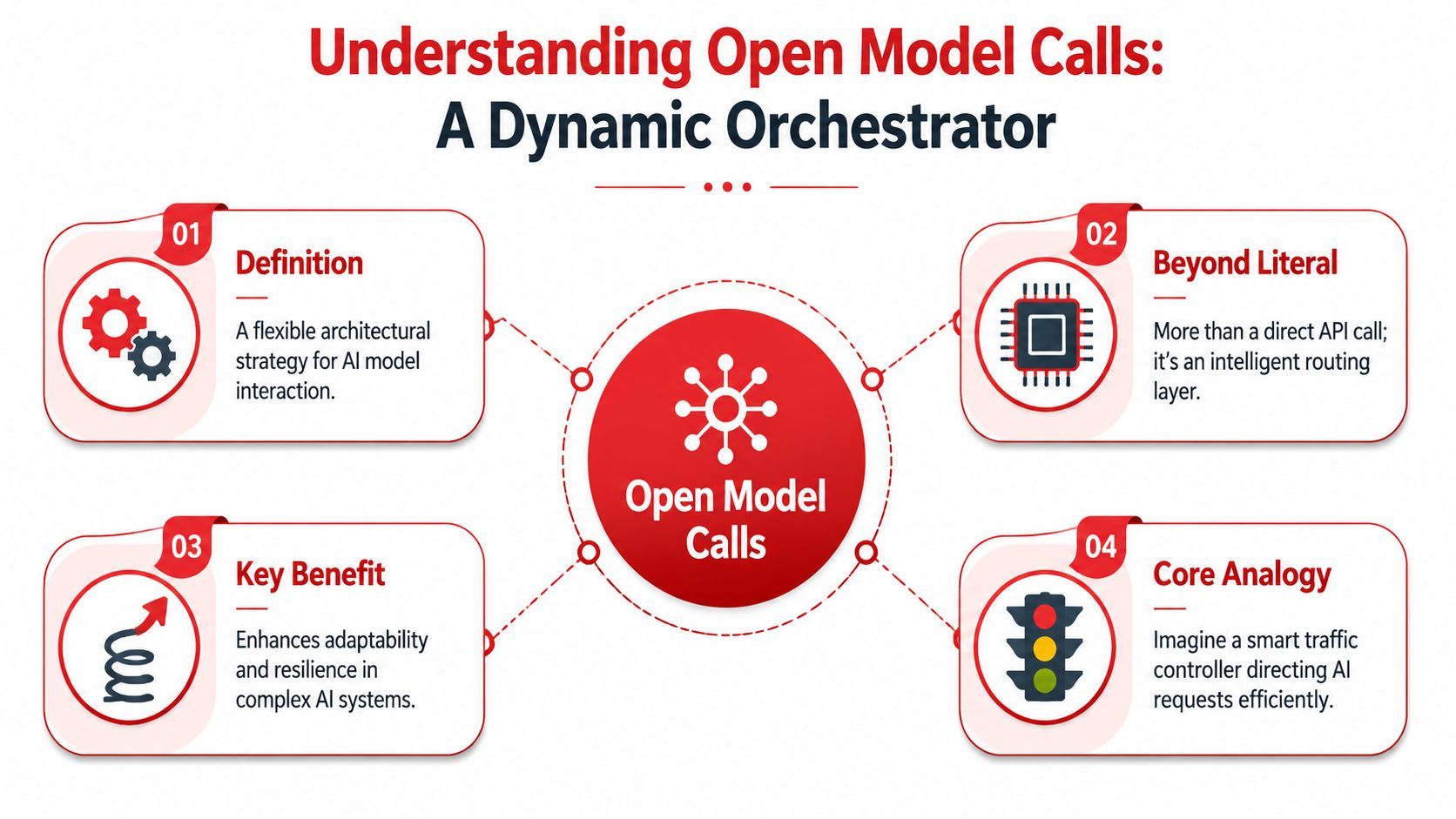
Open model calls are a production architecture where your application sends requests to a central decision layer, and that layer routes each request to the most appropriate model or provider based on policy.
A direct API call says, "use model X." An open model call says, "solve task Y under these constraints." That distinction is small in code and massive in operations.
The closest analogy is a CDN or API gateway. Your frontend doesn't usually care which cache node serves an asset. It cares that the asset arrives fast and reliably. Open model calls apply the same idea to inference. The application asks for classification, extraction, drafting, image generation, speech, or JSON output. A router decides whether OpenAI, Anthropic, Google, ElevenLabs, fal.ai, or a self-hosted model is the right path for that call.
The model shouldn't be the first decision your product code makes. It should be one of the last decisions your infrastructure makes.
Later in the section, it helps to see the pattern in motion:
The four parts that matter
Most implementations that work in production include four core parts.
The router is the visible part, but the registry and observability layer are what keep the system from becoming chaos. Without a registry, engineers route based on tribal knowledge. Without observability, every failure turns into guesswork.
Why this is different from a simple abstraction library
A wrapper SDK can hide provider-specific syntax. That's useful, but it isn't enough. Production routing needs policy. It needs to know that a support summarization call can go to a lower-cost model, while a contract extraction workflow needs stricter structured output. It needs to know what to do when a provider slows down, and whether a fallback should preserve JSON shape or switch to a safer text path.
A mature setup usually answers these questions centrally:
- Task intent: chat, classification, extraction, image, audio, tool use
- Constraints: max latency, budget sensitivity, schema requirements
- Risk level: customer-facing, internal-only, regulated, best-effort
- Fallback options: equivalent model, degraded mode, retry policy
- Version control: exact prompt version and exact model version used
If that sounds heavier than a normal model integration, that's because it is. You're no longer integrating a model. You're operating an inference system.
Comparing Open vs Closed Model Architectures
A team ships its first AI feature on one hosted model. Three months later, support wants a cheaper summarization path, legal wants stricter extraction output, and an outage at the provider turns a single dependency into a product incident. What looked simple at launch becomes expensive to change.
That is the core difference between closed and open model architectures.
A closed architecture usually means one provider, one primary model, and application code that calls it directly. An open model call architecture puts a routing and policy layer between the app and the models, so the execution target can change without rewriting every feature.
Both approaches are valid. They fail in different places.
Where closed architectures still work
Closed setups are good at getting a product live quickly. If the team has one narrow AI workflow, one provider that clearly meets the quality bar, and no immediate need for regional routing or failover, direct integration keeps the system easy to reason about.
That simplicity has value early on. Engineers can debug faster. Product teams have fewer variables. Procurement and security review only one vendor.
The problems show up as the product broadens:
- Pricing pressure gets pushed into the feature because every request uses the same pricing tier.
- Provider incidents affect every workflow built on that dependency.
- Prompt changes often end up coupled to application releases.
- New modalities or model classes create one-off integration paths that drift from each other over time.
A single-provider stack is often efficient for one use case. It gets awkward once the business expects the AI layer to serve several jobs with different cost, latency, and reliability requirements.
Where open model calls win
Open model calls help once model choice becomes an operating concern instead of an implementation detail. The benefit is not having more models for the sake of variety. The benefit is being able to assign the right model to the right job, then change that decision centrally as traffic, spend, and provider behavior shift.
Cost is usually the first reason teams make the jump. OpenAI notes in its model selection guidance that smaller, faster, and cheaper models are often enough for simpler tasks, while more capable models should be reserved for harder requests. In practice, that means routing basic classification, summarization, or tagging work away from premium models instead of letting every feature consume the highest-cost tier by default.
Reliability is the second reason. If one provider slows down or a model release changes behavior, an open architecture gives the platform team room to reroute traffic, fail over selectively, or degrade gracefully for lower-priority paths. That option matters more in production than it does in architecture diagrams.
Closed architectures optimize for launch speed. Open model calls optimize for control under changing production conditions.
Architecture Comparison Closed API vs. Open Model Calls
The tradeoff is also organizational
Teams often describe this as a technical architecture choice. In production, it is also an ownership choice.
With a closed setup, complexity spreads outward. Finance has limited visibility into which use cases drive spend. Incident response has fewer recovery options. Feature teams start making model decisions locally because there is no shared control point. Over time, the product ends up with AI behavior encoded in too many places.
Open model calls move that complexity into an explicit platform surface. That is better only if someone owns it. The router needs policies. The model catalog needs version control. Cost data needs to be attributable by feature or tenant. Without that operational discipline, a multi-model setup becomes a pile of ad hoc provider integrations with nicer terminology.
This is why many teams stay closed longer than they expected. The blocker is rarely access to models. It is the work required to run them as an internal service.
A useful decision rule
Choose a closed setup if all of these are still true:
- You have one primary AI workflow
- One provider clearly meets the quality bar
- Lock-in is acceptable for the current stage
- Spend, outages, and routing policy are not yet material product risks
Choose open model calls when any of these starts creating friction:
- different workflows need different quality and schema guarantees
- latency varies enough by region or provider to affect user experience
- fallback behavior needs to be deliberate, not improvised during incidents
- finance, ops, or product needs cost visibility by feature, customer, or task type
- model or prompt changes need to happen without tying every change to an app redeploy
Key Production Patterns for Routing and Fallbacks
A product team ships with one default model, then traffic grows, regions expand, and new features arrive. Suddenly the same routing rule is handling chat, extraction, backoffice jobs, and premium workflows. Costs drift up, latency gets uneven, and incident response turns into a debate about which provider someone hardcoded three sprints ago.
That is the point where routing stops being an implementation detail and becomes platform logic.
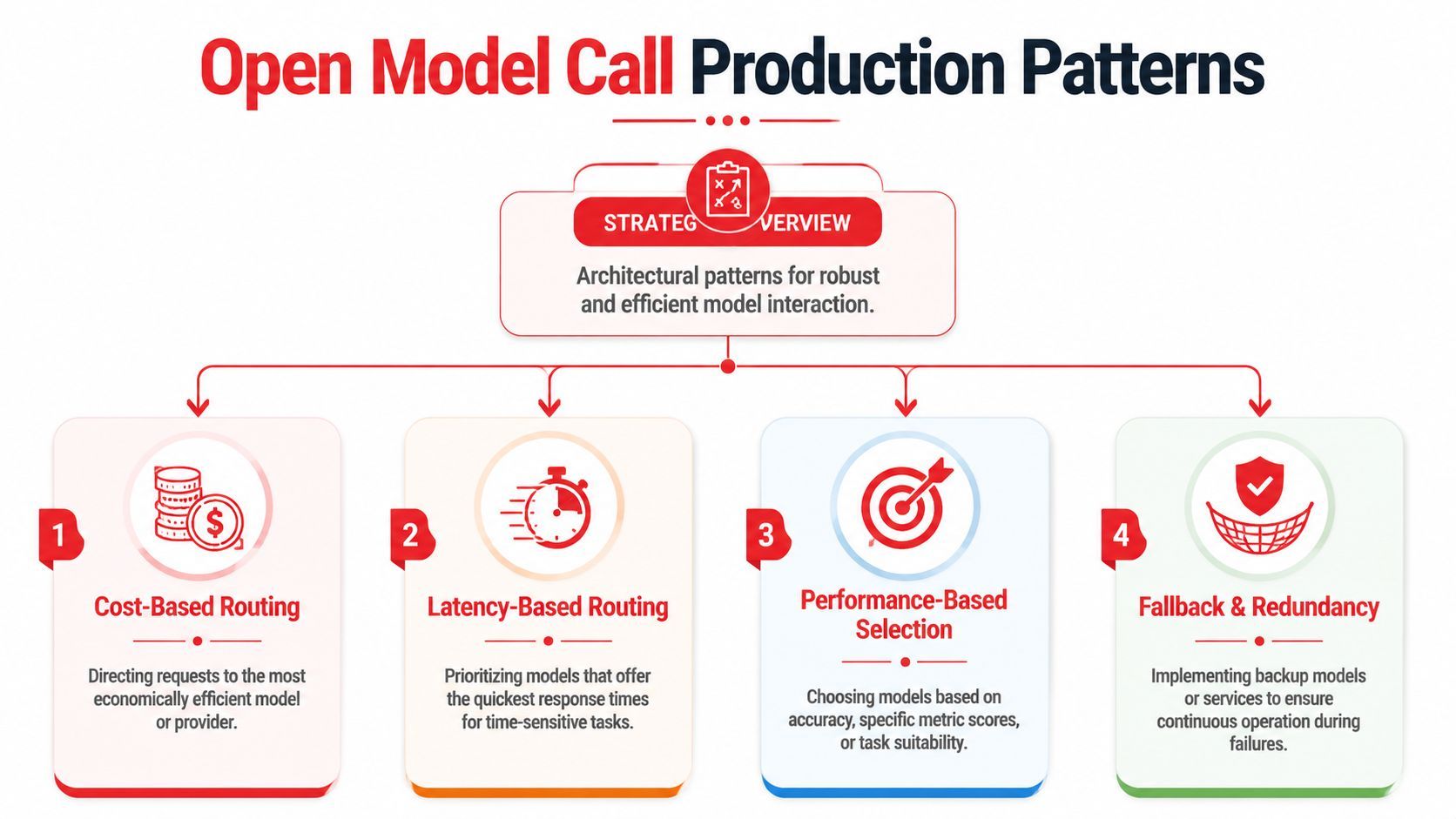
Route on cost when task quality bands are clear
Cost routing works when the team has already defined acceptable quality by task type. Without that agreement, every feature owner argues that their request needs the expensive path, and the router becomes a bypass target instead of a control point.
A practical policy starts with work that is easy to classify:
- Low-stakes text transforms go to a lower-cost model
- Structured extraction with validation goes to a more reliable model
- Premium user workflows can access a higher-cost tier
- Internal backoffice jobs can run on batch-friendly or slower routes
The hard part is governance, not configuration. Someone has to decide what error rate, schema adherence, and response quality are acceptable for each route. In production, "good enough" needs a written definition. Otherwise cost routing collapses the first time a stakeholder escalates one bad output.
Route on latency when users are waiting
Latency routing matters in user-facing flows where delay changes behavior. Chat, autocomplete, voice interactions, and guided copilots all punish hesitation faster than batch systems do.
Geographic routing is often the simplest win. Google Cloud documents common latency patterns and recommends serving users from the nearest available region to reduce round-trip time and improve responsiveness. The model may be identical. The user experience is not.
A production latency policy usually includes four controls:
- Identify real-time flows where delay is visible to the user
- Prefer nearby endpoints when output quality stays within the accepted range
- Cap retries so a transient miss does not become a multi-second stall
- Use streaming when the provider supports it and partial output improves the UX
Fast enough often wins. A slightly better answer that arrives after the user has lost context is usually the wrong route.
Route on capability when task type changes
Capability routing should be designed early because it shapes everything else. If the system handles text generation, transcription, image work, tool use, and structured JSON, one generic route policy will fail in predictable ways.
A few examples show why:
- Speech transcription needs route logic tuned for audio handling, timestamps, and long input limits
- Image generation needs fallback rules that account for style drift and moderation differences
- JSON extraction needs models chosen for schema reliability, not elegant prose
- Tool-using agents need tighter timeouts, stronger guardrails, and more detailed execution logs
Operationally, a model registry starts paying for itself. The registry should define what each model can do, what output formats it supports, whether it streams, whether it can call tools, and whether it is approved for customer-facing traffic. Without that layer, routing logic leaks into feature code and teams end up rediscovering the same incompatibilities during incidents.
Fallbacks need policy, not panic
Fallback design fails when teams treat every backup route as interchangeable. A second provider is only a real fallback if it preserves the contract the caller depends on. That includes output shape, latency envelope, safety behavior, and cost boundaries.
Start with failure classes and decide the response before the outage happens.
The order matters. Try an equivalent route first. If that is unavailable, degrade the experience in a way the product team has explicitly approved. For example, return a shorter answer, disable tool use, or fall back from live generation to cached guidance. Do not let the router improvise expensive or incompatible retries under pressure.
A production fallback policy should have three properties:
- Equivalent first. Preserve output shape and user expectations whenever possible.
- Degraded second. Return a simpler experience when equivalence is not available.
- Auditable always. Log the original route, fallback route, failure class, and final outcome.
Teams usually discover the full value of this work during incidents. The router is not just deciding which model to call. It is deciding how much inconsistency, delay, and spend the product is allowed to absorb before the user feels it.
Best Practices for Management and Observability
A multi-model stack usually looks healthy right up until the first hard incident. A product manager asks why EU users started getting shorter answers on Thursday afternoon, support has three screenshots that do not match each other, finance sees a spend spike from one feature, and the engineering team cannot answer a simple question. Which model path ran for those requests?
That is the management problem. Open model calls give teams flexibility, but they also create more moving parts than a single-model integration. You are no longer tracking one prompt and one provider. You are operating routing policy, prompt revisions, model versions, fallback behavior, cost controls, and regional differences at the same time.
Log every call so you can reconstruct it
Aggregate dashboards help with trend detection. They do not explain a bad answer.
Each request needs a trace record that captures the provider, exact model identifier, prompt ID and version, route decision, latency, token usage, response format, safety result, error class, and fallback chain. If tool calls are involved, log those too. Without that level of detail, teams end up debugging from screenshots, partial app logs, and vendor dashboards that were never meant to explain a single user-visible failure.
The practical test is simple. Can an engineer take one bad response from production and reconstruct the full execution path in a few minutes? If not, observability is still too thin.
"We used Claude" or "we used GPT" is not enough. Production debugging starts with the exact route, prompt revision, model version, and timing for that specific call.
OpenTelemetry gives teams a useful baseline for traces, metrics, and logs across distributed systems, including AI gateways and downstream services: https://opentelemetry.io/
Prompt versioning needs a release process
Prompt management breaks down fast when prompts live partly in code, partly in vendor consoles, and partly in team chat. The result is familiar. Output changes, nobody knows which edit caused it, and rollback becomes guesswork.
A production-safe prompt setup should include:
- A stable prompt ID referenced by the application
- An immutable version or revision for every change
- Environment separation for dev, staging, and production
- Schema linkage when the response must match a contract
- Rollback support without waiting for an app deploy
Treat prompt edits like behavior changes, because that is what they are. The operational question is not whether a prompt is "better." It is whether the new version improved the task without breaking latency, cost, or downstream parsing.
Cost visibility has to follow the route
Teams often track total provider spend and stop there. That is not enough once traffic is routed across multiple models.
Cost needs to be attributable by feature, route, customer tier, and job type. Otherwise a batch enrichment job can unexpectedly consume the same budget that was meant for an interactive support workflow. The invoice tells you what happened too late. The routing layer should tell you while it is happening.
A sane baseline includes:
- Per-feature budgets so one path cannot absorb shared capacity
- Provider and model spend visibility mapped to request classes
- Rate controls for background jobs, retries, and agent loops
- Central secret management instead of keys spread across services
- Least-privilege access so experiments cannot touch production credentials
Production trade-offs take concrete form. The cheapest route may increase repair traffic. The fastest route may fail schema validation often enough to raise total cost. Good management shows the full cost of the request path, not just the first model call.
Ownership matters more than policy volume
Governance does not need a committee and six approval stages. It needs clear ownership and a small number of rules that survive real traffic.
For every model route, document:
- The task this route serves
- The required output contract
- The primary model and allowed versions
- The approved fallback path
- What gets logged and retained
- Who owns quality, spend, and incident response
Unowned routes drift first. They accumulate quiet prompt edits, ad hoc retries, and exceptions that only exist in one engineer's head. That works in a prototype. It fails in production.
A Practical Implementation Workflow
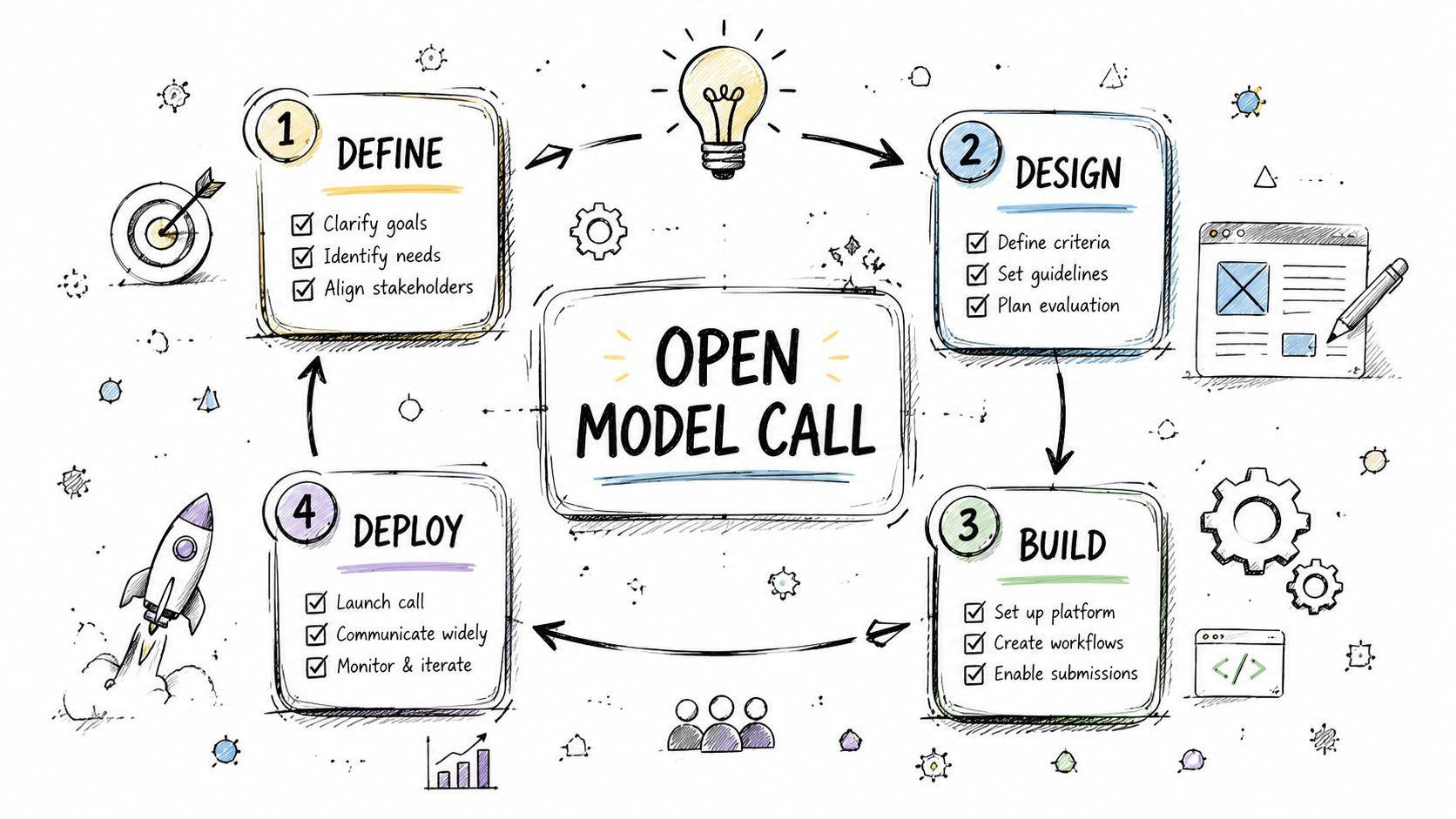
You don't need a giant rewrite to start using open model calls. Start by introducing a thin gateway between the app and providers. Keep the first version narrow and deliberate.
Start with tiers not providers
Don't begin by listing every model you might use. Start by defining tiers.
For example:
- Tier A for premium reasoning or sensitive structured output
- Tier B for general chat and drafting
- Tier C for low-cost transforms, tagging, and batch jobs
- Specialized tiers for image, audio, video, or speech
That gives product teams a language they can use without debating provider names in every planning meeting.
Centralize prompts and routing policy
The app should send intent and context, not handcrafted provider logic. A request payload might look like this:
const taskRequest = {
  task: "support_summary",
  tier: "B",
  userRegion: "eu",
  responseFormat: "json",
  promptId: "support-summary",
  promptVersion: "12",
  maxLatencyClass: "interactive"
};
Then the gateway applies policy:
function selectRoute(req) {
  if (req.task === "support_summary" && req.responseFormat === "json") {
    return { provider: "anthropic", model: "preferred-json-model", fallback: "openai-compatible-backup" };
  }

  if (req.tier === "C") {
    return { provider: "open-source-host", model: "low-cost-text-model", fallback: "secondary-low-cost-model" };
  }

  if (req.userRegion === "eu" && req.maxLatencyClass === "interactive") {
    return { provider: "regional-endpoint", model: "nearby-fast-model", fallback: "global-fast-model" };
  }

  return { provider: "default-provider", model: "general-purpose-model", fallback: "safe-general-backup" };
}
The names above are intentionally conceptual. The point is where the decision lives.
Build the gateway thin
The first gateway doesn't need to handle every edge case. It needs to do a few things well:
- Resolve prompt version
- Select route
- Call provider adapter
- Validate output shape
- Apply fallback when policy allows
- Emit one consistent log record
That provider adapter layer matters because each vendor has different request syntax, streaming behavior, and error semantics. Normalize that once, not repeatedly inside product features.
Make logs readable by humans
Logs should help an engineer answer "what happened" in under a minute. If your log format requires cross-referencing five services, it isn't good enough.
A readable event might look like this:
{
  "task": "support_summary",
  "prompt_id": "support-summary",
  "prompt_version": "12",
  "provider": "primary-provider",
  "model": "general-json-model",
  "fallback_used": false,
  "latency_ms": "captured",
  "cost": "captured",
  "output_valid": true,
  "user_region": "eu"
}
That record becomes much more useful when every route emits the same shape. Consistency is what makes search, debugging, and cost review manageable later.
Conclusion The Future Is Composable AI
Open model calls are less about open-source ideology and more about production control. Teams outgrow the single-model pattern as soon as AI features have different cost profiles, latency needs, failure modes, and output contracts.
The useful shift is architectural. Stop thinking of the model as a fixed dependency. Start treating it as a runtime resource managed by policy. That enables better routing, cleaner fallbacks, safer prompt changes, and debugging that doesn't rely on memory and screenshots.
You don't need to build the full system on day one. Start with one routed task, one fallback rule, and one logging standard. If that works, add prompt versioning. Then add cost controls. Then add capability-based routing. The stack becomes composable one layer at a time.
The teams that do this well won't just ship more AI features. They'll operate them with fewer surprises.
If you want the production layer without hand-building every router, prompt registry, fallback rule, and observability screen, Supagen gives teams a unified AI backend for managing versioned prompts, multi-provider routing, per-call logs, fallbacks, and cost tracking through one integration. It's a practical way to move from hardcoded model calls to a system you can run in production.