
Large Action Model: Architecture & AI Deployment 2026
You're probably seeing the same pattern many product teams are seeing right now.
A user asks your AI assistant to “review these support tickets, update the CRM, draft replies, and escalate anything risky.” The model writes a sharp summary. It may even suggest the right next steps. Then it stops. Someone still has to open Salesforce, click through the queue, copy values into fields, trigger the workflow, and verify nothing broke.
That gap matters more than most demos admit. Understanding a request isn't the same as completing it. A chatbot can sound capable while leaving the actual work untouched.
That's where the large action model enters the picture. It changes the unit of output from words to actions. For builders, that difference is not branding. It affects training data, runtime behavior, testing, safety, observability, and whether your “agent” survives contact with a messy production environment.
Table of Contents
- What Are Large Action Models and Why Do They Matter
- LAMs vs LLMs The Shift from Predicting Words to Actions
- Inside a Large Action Model How They Think and Act
- From Chatbots to Agents Real-World LAM Use Cases
- The Builder's Dilemma True LAMs vs LLM-Agents
- Putting LAMs to Work A Production Implementation Guide
- The Future is Action-Oriented
What Are Large Action Models and Why Do They Matter
First encounters with AI often occur through language. You type a prompt, the model answers, and everyone judges quality by how smart the text sounds. That works for summarization, drafting, brainstorming, and analysis.
Then the product roadmap expands. You want the system to do something. Book the hotel room after finding the best option. Process the return after deciding it qualifies. Move from “here's what you should do” to “it's done.”
A Large Action Model, or LAM, is built for that second category. According to Emergent Mind's overview of large action models, LAMs are parameterized policies that map high-level tasks and observations directly to executable action sequences, while LLMs primarily predict the next word to generate text. That sounds academic, but the practical meaning is simple: the system's job is not just to talk about the world. Its job is to change the world.
Think about a common workplace request: “Reschedule the QBR, notify attendees, and update the project tracker.” A language model can explain the steps beautifully. A large action model is aimed at carrying them out across calendars, email, and internal tools.
Practical rule: If success is measured by whether a task got completed, not whether the answer sounded good, you're in LAM territory.
Modern AI products are drifting from chat surfaces toward agents. Users don't just want answers. They want outcomes. In that shift, the system needs perception, reasoning, and execution tied together tightly enough to handle real interfaces and multi-step workflows.
LAMs aren't a replacement for LLMs. They're what you reach for when language alone stops being enough.
LAMs vs LLMs The Shift from Predicting Words to Actions
A product manager asks for a travel assistant. In the demo, the system explains flight options clearly, summarizes hotel tradeoffs, and produces a tidy itinerary. In production, the ultimate test arrives. Can it select dates, handle a fare change, retry after a timeout, and finish the booking without creating a mess?
That gap explains the shift from LLMs to LAMs.
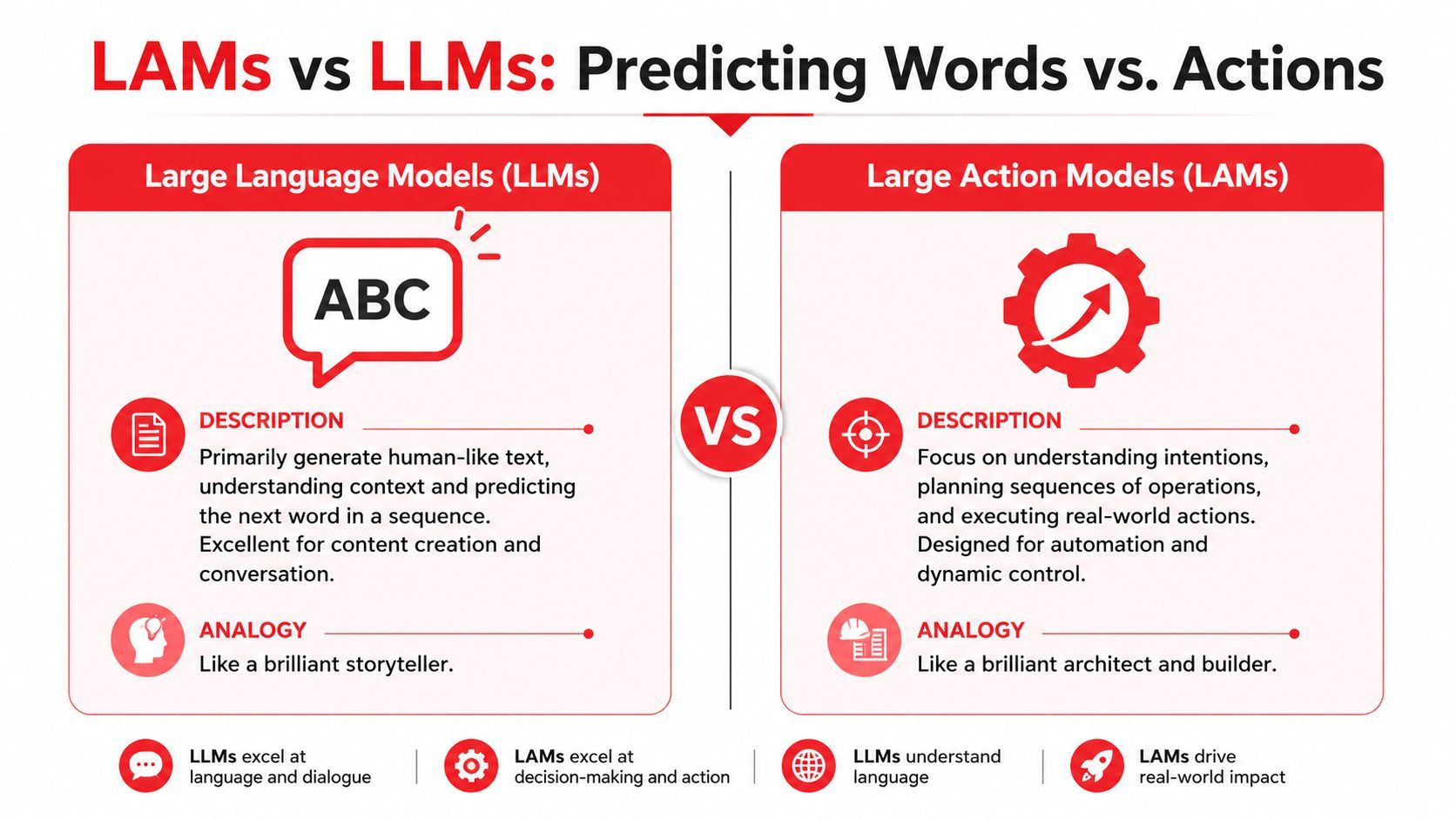
An LLM is trained to predict the next token in a sequence. Its native skill is language generation. A LAM is trained around action selection under changing state. Its native skill is choosing the next operation that moves a task closer to completion.
A simple mental model
An LLM works like a brilliant analyst in a control room. It can explain the process, recommend a strategy, and generate polished instructions. A LAM works like the operator at the console. It checks the current state, takes the next valid action, observes what changed, and continues until the task is complete or stopped safely.
That distinction matters because production systems fail in operational details, not in polished explanations.
If a user says, “Find the cheapest flight, book a hotel near the venue, and add it to my itinerary,” an LLM can produce a strong plan. A LAM-oriented system is built to interact with the booking flow itself: read page state, choose filters, enter data, recover from UI changes, and verify the result. The output is not just a sentence. It is a sequence of state-changing operations.
Large Action Model vs Large Language Model at a Glance
For builders, the training difference is the part that cuts through the hype. Many teams assume an LLM becomes a LAM once you attach tools, browser access, or a function-calling wrapper. Sometimes that setup is enough for light workflows. It is not the same thing as a model trained to act reliably over many steps while the environment keeps changing.
A useful analogy is self-driving software versus a navigation app. A navigation app can describe the route perfectly. Driving software has to steer, brake, re-check the road, and correct mistakes in real time. LLMs are strong at describing and reasoning. LAMs are designed around execution under feedback.
That is why action models are often narrower in scope. Breadth helps a chat assistant. Reliability in a bounded operating domain helps an action system. In production, teams usually care less about whether the model can discuss any topic and more about whether it can complete a defined workflow with acceptable error rates, latency, and auditability.
A model can sound highly competent and still be a weak operator if it was not trained and evaluated for action.
For product teams, the practical split is straightforward:
- Use an LLM when the product's value is generating, transforming, or explaining information.
- Use a LAM-style system when the product must manipulate software, devices, or workflows to finish a task.
- Use both when the system needs language reasoning up front and disciplined execution afterward.
That last pattern is where confusion usually starts. Many products labeled “agents” are still LLM-led systems with tool calls and prompt scaffolding. They can be useful. But if your deployment depends on repeatable action in messy real environments, the architectural and training differences are not branding details. They determine whether the system helps in production or breaks the first time the workflow drifts off the happy path.
Inside a Large Action Model How They Think and Act
A customer asks an assistant to reorder office supplies. The request sounds simple until the vendor portal shows a login timeout, one item is out of stock, the shipping address has changed, and a purchase approval banner blocks checkout. A language model can describe what should happen. A large action model has to keep the task on track while the environment keeps changing.
That difference shows up in the architecture.
The closed loop
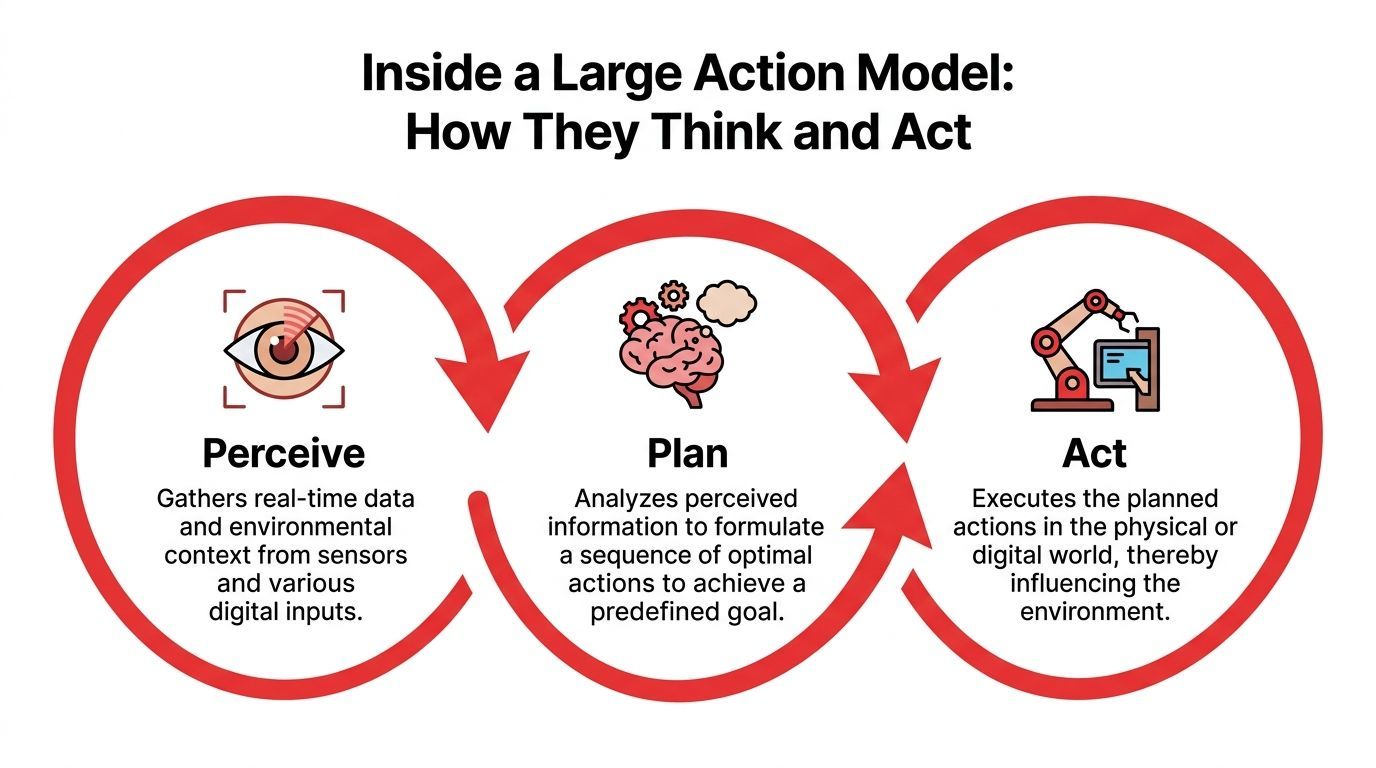
A LAM operates as a control loop. It observes the current state, selects the next action, executes it, then checks the result before continuing. Builders should read that carefully because it marks a fundamental break from many so-called agent systems. The core problem is not extended text reasoning. The core problem is reliable state transition under feedback.
In practice, the loop usually has three parts.
- Perceive
The system reads the environment as it exists now. In software, that may include buttons, fields, page structure, validation messages, table contents, and modal dialogs. In physical systems, it may include camera frames, position, force, or other sensor data. - Plan
The model chooses the next action that best advances the goal from the current state. Good action systems do not depend on a perfect plan written at step one. They re-evaluate after each interaction because the world rarely stays still long enough for a fixed script to survive. - Act
The system emits an executable command. It might click, type, scroll, select, submit, call an API, or send a motion command to a robot. That action changes the environment, which creates the next observation.
A thermostat is a useful analogy. It does not write a brilliant essay about temperature control. It checks the room, compares the state to the target, acts, then checks again. LAMs apply the same closed-loop idea to much messier tasks.
What “thinking” means inside a LAM
People often hear "model" and assume one giant network is doing everything. Production systems are usually more modular.
One component may turn a screen, DOM tree, or sensor stream into structured observations. Another tracks task state, such as what the user asked for, what has already been tried, and what constraints still matter. A policy model or planner chooses the next action. An execution layer converts that decision into a real command and records what happened.
That modularity matters for deployment. If a team treats action as "an LLM plus tool calls," they often miss the hard parts: state tracking, recovery after failed actions, permission boundaries, and verification that the world changed in the expected way. Those are system design problems as much as model problems.
A concrete example
Consider a pizza ordering site.
The goal is straightforward: order a large pepperoni pizza for delivery tonight. The execution is not. The homepage layout may vary, the store selector may appear before the menu, an upsell modal may interrupt the flow, and the cart may automatically switch stores if the address falls outside a delivery zone.
A LAM-style system would work through the task step by step:
- detect the entry point for starting an order
- choose delivery
- read the current menu and available options
- select the right size and topping
- verify that the cart still matches the goal
- dismiss or answer interruptions such as upsells
- enter address and contact details
- confirm the final state before submitting
The hard part is stateful control. Every action changes the problem the model has to solve next.
The challenge is not understanding the word "pepperoni." The challenge is choosing the right next action after the page changes, then noticing when the result does not match the intent.
This is also why evaluation looks different. A text model can be scored on next-token prediction or answer quality. An action system needs task completion, step accuracy, recovery behavior, latency, and safety checks. For builders, that is the practical lesson. If production success depends on the system doing work rather than discussing work, the loop around the model becomes part of the model.
From Chatbots to Agents Real-World LAM Use Cases
The easiest way to spot a good LAM use case is to look for tasks with three traits: they span multiple steps, they involve changing state, and users care about completion more than conversation.
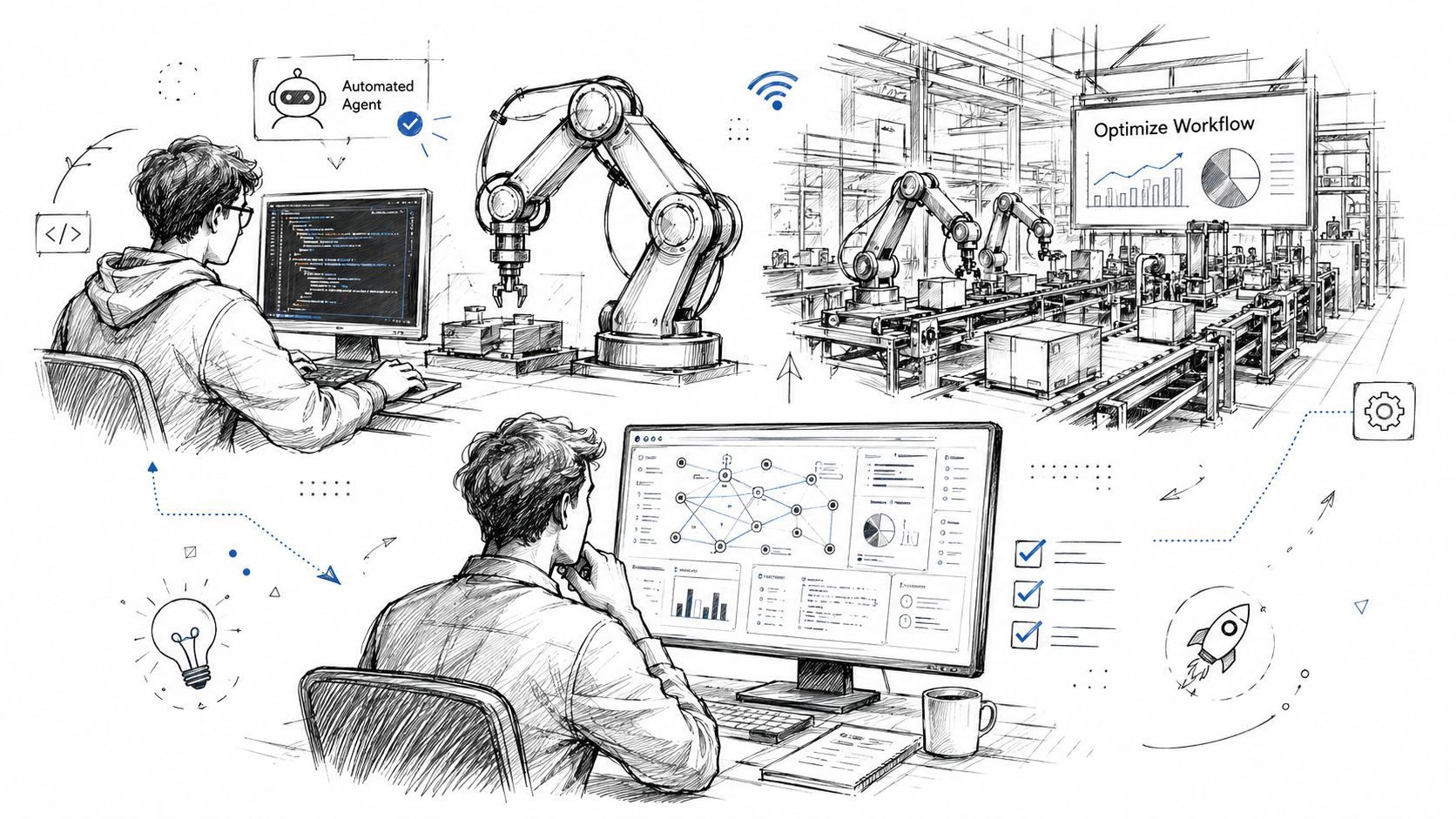
Research summarized by DigitalOcean's explanation of large action models describes LAMs as specialized systems that can complete complex real-world tasks autonomously by understanding user intent from inputs such as text, voice, and images. That makes them a fit for software operations, customer workflows, and physical control.
Consumer workflows
A strong consumer example is travel coordination.
A user says, “Plan my trip to Austin, arrive before the morning kickoff, stay near the convention center, and keep it within policy.” A chat assistant can suggest options. A LAM-style agent can move across airline, hotel, and itinerary systems, compare availability, select parameters, and complete the sequence.
That kind of work is messy. Dates shift. Rooms disappear. Forms validate differently on different sites. Action models earn their keep when the path isn't a single API call.
Enterprise operations
Now move into internal tooling.
A support operations team might want an agent to process incoming returns. The request sounds simple: verify eligibility, update the order record, create the return label, notify the customer, and flag anything unusual for human review. The actual work crosses a helpdesk, an order system, and a shipping platform.
A LAM-oriented workflow handles this better than a pure chatbot because it can treat each interface as part of one larger task. It doesn't just classify the issue. It moves the issue through the system.
Here's a short demo format that helps teams picture the jump from chat to action:
Productivity agents
Personal productivity tools are another natural fit.
Consider a command like, “Move my one-on-ones to next week, send a note to each attendee, and block prep time before the board meeting.” This isn't one task. It's a chain of related actions across calendar, email, and task systems.
A useful pattern is that the user expresses the goal once. The agent handles the operational details:
- Calendar handling: It finds conflicts, proposes valid slots, and updates events.
- Messaging follow-through: It drafts and sends attendee notes with the new times.
- State synchronization: It updates reminders or project trackers so the rest of the stack stays aligned.
Users rarely want “AI that can navigate a UI.” They want “AI that took care of it.”
That's the broader shift. Chatbots answer questions. Agents complete workflows. Large action models are one of the clearest architectural moves toward the second category.
The Builder's Dilemma True LAMs vs LLM-Agents
Here, hype gets expensive.
A lot of products are presented as LAMs when they're really LLMs with tool access. That doesn't make them useless. Plenty of LLM-agents are valuable. But the architecture is different, and the difference matters when you're deciding what can be trusted in production.
Why the market is confusing
The hardest part is that both systems may appear similar in a demo.
A user gives a high-level task. The system reasons about it. It calls something external. It returns a result. From the outside, that can look like “action.” But Trinetix's analysis of the LAM versus LLM-agent gap points out a key issue: many marketed LAMs are standard LLMs with tool-bolting rather than true action-first training, and public benchmarks that cleanly separate the two are still missing.
That means builders need to inspect the training story, not just the product label.
A rough way to understand it:
- LLM-agent: A general language model reasons in text, then chooses from a set of tools or functions.
- True LAM: The system is trained with actions as first-order objects, so next-action prediction is part of the core learning objective.
Those are not interchangeable, especially under uncertainty.
Questions to ask vendors and your own team
When someone says “we use a large action model,” ask questions that reveal the architecture.
- Was the model trained on action sequences? If the answer is vague, you may be looking at a wrapper around a general LLM.
- What is the unit of optimization? If performance is framed mostly around reasoning quality or prompt design, that's a clue.
- How does it handle changing interfaces? A real action system should have a story for state perception, adaptation, and recovery.
- What happens when the environment diverges from the expected path? Tool-calling plans often fail sharply here.
Evaluation lens: Ask whether actions are part of the model's training objective or only part of its runtime orchestration.
The lack of public benchmarks makes this more annoying than it should be. You can't rely on category names. You have to evaluate behavior under real workflow conditions. Test for recovery after a UI shift. Test whether the system can maintain task state over multiple steps. Test whether it knows when to stop and hand off.
If your use case is lightweight orchestration over stable APIs, an LLM-agent may be enough. If you need reliable, repeated action in dynamic environments, the training distinction becomes much more important.
Putting LAMs to Work A Production Implementation Guide
A team ships a browser automation demo on Friday. On Monday, the target app changes one field label, adds a confirmation modal, and slows one API call. The demo still looks fine in a happy-path video. The production system starts missing steps, retries the wrong action, and leaves operators guessing whether the problem came from state detection, policy selection, or the execution layer.
That gap is the key production problem with LAMs. Builders do not need more hype about agents that "use tools." They need an architecture that can survive changing interfaces, partial failures, and long action chains under real constraints.
The development path described in this overview of the five-step LAM pipeline includes data collection, model training, offline sandbox testing, real-world integration, and live performance evaluation. That sequence maps well to deployment because each stage answers a different operational question: what the model should learn, how it should act, where it breaks, how much access it gets, and how you catch drift after launch.
The five-stage path to deployment
1. Collect action data, not just text
A production LAM needs examples of state paired with action and outcome. In software workflows, that usually means UI snapshots, event histories, tool calls, permission context, and success or failure signals. Text transcripts alone are like reading a driving manual without seeing the road, pedals, or steering wheel.
2. Train for a narrow operating environment first
Production teams often get more reliability from a model tuned for a bounded job than from a general model wrapped in prompts. If the job is claims processing or calendar scheduling, optimize for those action patterns, error modes, and latency requirements. Broad reasoning matters, but repeated task completion matters more.
3. Test in a sandbox where every failure is inspectable
Before the system touches a live CRM, payment flow, or customer account, give it a realistic but reversible environment. In this environment, you find brittle selectors, missing state, bad retries, and unsafe assumptions. A sandbox is the flight simulator for an action model. You use it to study decisions before those decisions carry cost.
4. Roll out with tight permissions and narrow scope
Start with workflows that are high value but operationally contained. Limit write access. Require approval gates for risky actions. Expand only after the traces show that the model can complete the task and recover when the environment shifts.
5. Evaluate live behavior as a sequence, not a final result
A chatbot can look acceptable if the answer sounds plausible. A LAM can look acceptable right up to the step where it clicks the wrong button. Measure what happened at each action boundary: what state the model saw, what it chose, what executed, and what changed afterward.
What usually breaks in production
Production failures are often ordinary. That is why they are easy to underestimate.
- Perception drift: The interface or environment changes, and the system misreads the current state.
- Policy drift: The chosen action still sounds reasonable, but it no longer moves the workflow toward completion.
- Execution drift: The command is valid, but the receiving system now responds with a different screen, schema, or delay pattern.
- Recovery failure: The system encounters an unexpected branch and keeps going instead of pausing, asking for help, or taking a safe fallback.
- Observability gaps: The task fails, but the team cannot reconstruct which step caused the failure.
For builders, this is the practical dividing line between a true action-oriented system and an LLM-agent wrapper. If your stack only logs prompts and final outputs, you are missing the control surface needed for production action.
What a production layer must handle
The requirement is not "connect a model to tools." The requirement is to operate an action system that changes over time and can still be debugged, governed, and improved.
A strong production layer should let you:
- Route models by role: one model for state interpretation, another for action selection, another for verification if needed
- Version prompts, policies, and action schemas: changes should be reviewable and reversible
- Trace every step: inputs, outputs, action choices, latency, cost, and environment responses should be visible per task
- Set fallback paths: if one provider degrades or one policy fails, the workflow should fail safely without a full redeploy
- Apply permission boundaries: separate read, propose, and execute rights by workflow and risk level
- Support human intervention: operators should be able to inspect, approve, retry, or terminate a task in progress
That setup matters more for LAMs than for content generation systems because the blast radius is different. A weak summary wastes time. A weak action chain can alter records, trigger the wrong transaction, or create compliance issues that are much harder to unwind.
The production lesson is simple. Treat actions as a system design problem, not just a prompting problem. Teams that do this well build around state, control, evaluation, and recovery from day one.
The Future is Action-Oriented
The center of gravity in AI products is moving from conversation to completion.
LLMs made software feel more fluent. They gave products a natural language surface and enabled a huge wave of copilots, assistants, and generation tools. But language was never the full destination. Teams want systems that can carry intent across the last mile into execution.
That's why the large action model matters. It represents a shift in what the model is for. Not just answering. Acting. Not just reasoning about workflows. Moving through them.
For builders, the biggest practical lesson is this: don't evaluate these systems by demo smoothness alone. Ask what the model is trained to do. Ask how it handles changing state. Ask how failures are traced. Ask whether the product is a real action-first system or an LLM-agent with a nice wrapper.
There's also a healthy note of caution. The category is still muddy. Public benchmarks that separate true LAMs from tool-using LLM-agents are limited. Training data for effective real-world action is still hard to assemble. Multimodal action remains harder than the marketing suggests. None of that kills the category. It just means builders should stay technical when the branding gets loud.
The likely future interface isn't chat alone. It's collaboration with systems that can understand a goal, operate within constraints, and complete work across software and physical environments. The teams that win won't just pick smart models. They'll build the production layer that makes action reliable.
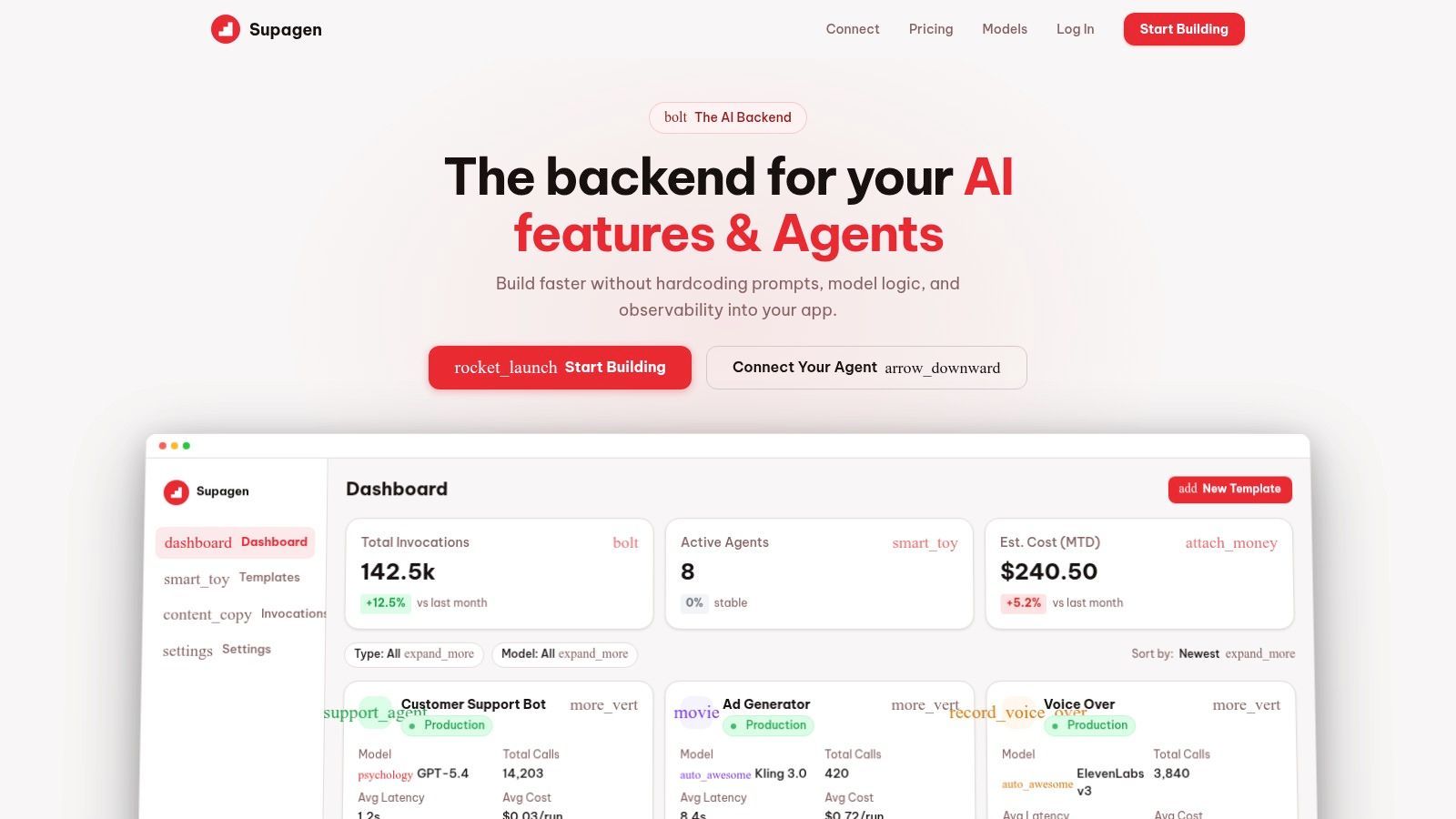
If you're building AI features or agents and want the production layer handled cleanly, Supagen is worth a look. It gives teams one backend for prompt management, model routing, observability, fallbacks, and cost tracking, so you can iterate on agent behavior without hardcoding every model decision into your app.