
Best Open Source LLMs of 2026: Pick Your Ideal Model
Your prototype is live, the hosted API got you through the demo, and now the hard question shows up in an ops review: which open model can you run in production without blowing up latency, cost, or legal review?
That question gets messy fast. “Open source LLM” covers several very different realities. Some models ship with permissive licenses. Some provide open weights but add meaningful usage limits. A few are open in the stronger sense, with training code, data details, and reproducibility work that let research and governance teams inspect what they are deploying.
The practical gap between those options is large. A model can look great on benchmarks and still be a bad production choice if it is expensive to serve, difficult to quantize cleanly, weak at tool use, or unpredictable under real traffic. Another model can be less impressive on paper and still win because it fits your hardware budget, supports your commercial use case, and gives you acceptable latency with room for fallback and routing.
Open models are no longer just a research side project. Product teams now treat them as a real deployment path for chat, coding, retrieval, internal agents, and on-device features. The selection process should reflect that reality.
This guide approaches the problem the way an ML engineer or AI product lead has to approach it in practice. Model quality is only one variable. Licensing terms affect where you can ship. Model size affects whether self-hosting stays a deployment task or turns into an infrastructure program. Operational details like batching, time-to-first-token, context handling, and failure modes often matter more than a few benchmark points.
The best open source LLM is the one that fits your product, your constraints, and your path to production. In many cases, that means choosing more than one model and putting a routing layer in front of them so the small model handles cheap traffic, the stronger model catches hard requests, and your backend gives you one place to manage prompts, policies, and observability.
Table of Contents
- 1. Llama 3 8B and 70B
- 2. Mixtral 8x7B
- 3. Mistral 7B
- 4. Qwen2.5 Qwen family
- 5. Microsoft Phi-3
- 6. Gemma 2
- 7. StarCoder2
- 8. OLMo 2 Allen Institute for AI
- 9. MPT-7B MosaicML and Databricks
- 10. Falcon 180B
- Top 10 Open-Source LLMs Comparison
- Your Next Step From Model Selection to MVP
1. Llama 3 8B and 70B
A team ships a promising internal assistant on Friday, then spends the next two weeks learning that model choice was the easy part. Latency misses the target, GPU costs climb, and legal wants a clean answer on license terms. That is why Llama stays near the top of the shortlist. It is not just a model family. It is one of the few open-weight options with enough ecosystem support to survive contact with production.
The choice isn't "Llama or not." It is 8B or 70B, and those are different bets.
Llama 3 8B is the practical starting point for teams still validating prompts, retrieval quality, and safety controls. It is cheaper to serve, easier to quantize, and more forgiving if your product architecture is still changing every sprint. For many support bots, internal knowledge assistants, and structured extraction jobs, 8B is enough to prove whether the workflow has value before you spend on larger infrastructure.
Llama 3 70B earns its keep in higher-stakes paths where better instruction following and stronger general capability change user outcomes. The trade-off is operational, not academic. Serving 70B well means more careful hardware planning, tighter concurrency management, and less room for sloppy prompt design. Teams often reach for it to close quality gaps that are partly model-related and partly system-related.
That distinction matters because Llama works best as part of a roadmap, not a single final choice.
Why teams keep starting with Llama
Three things keep Llama in circulation. First, the ecosystem is mature enough that engineers can usually find working examples for quantization, fine-tuning, adapters, and serving stacks without inventing everything from scratch. Second, the license is familiar enough that procurement and legal can often review it faster than more unusual alternatives. Third, it gives product teams optionality. You can start with one size, test another, and keep much of the surrounding stack intact.
That last point is underrated.
If the goal is to get from evaluation to MVP, Llama reduces coordination cost across engineering, infra, and product. The model quality matters, but the surrounding operational surface matters just as much. A model family with broad tool support is easier to benchmark, swap, and route inside a unified backend later if you decide one model should handle fast-path requests and another should handle harder cases.
Practical rule: Pick the model family your team can serve, debug, and monitor under real load, not the one that looked best in a benchmark screenshot.
Where it fits and where it bites
Llama's strengths are broad usefulness and ecosystem depth. Its weakness is that teams can treat it as a default answer long after the workload has become more specific. If your application is code-heavy, multilingual, or optimized around extreme cost efficiency, another model may fit better. Llama is often the best starting point because it lowers execution risk. It is not always the best long-term specialist.
The 8B model can expose system problems quickly. Weak retrieval, loose prompts, and missing guardrails show up fast because the model has less headroom to paper over them. That is useful. The 70B model can produce better outputs, but it can also hide bad architecture for longer and charge you more for the privilege.
For teams asking, "What is the best open source llm to start with?" Llama is still the most honest first answer in many production settings. It gives you a stable baseline, a large support ecosystem, and a clean path into a multi-model setup once traffic patterns make routing worth the extra complexity.
2. Mixtral 8x7B
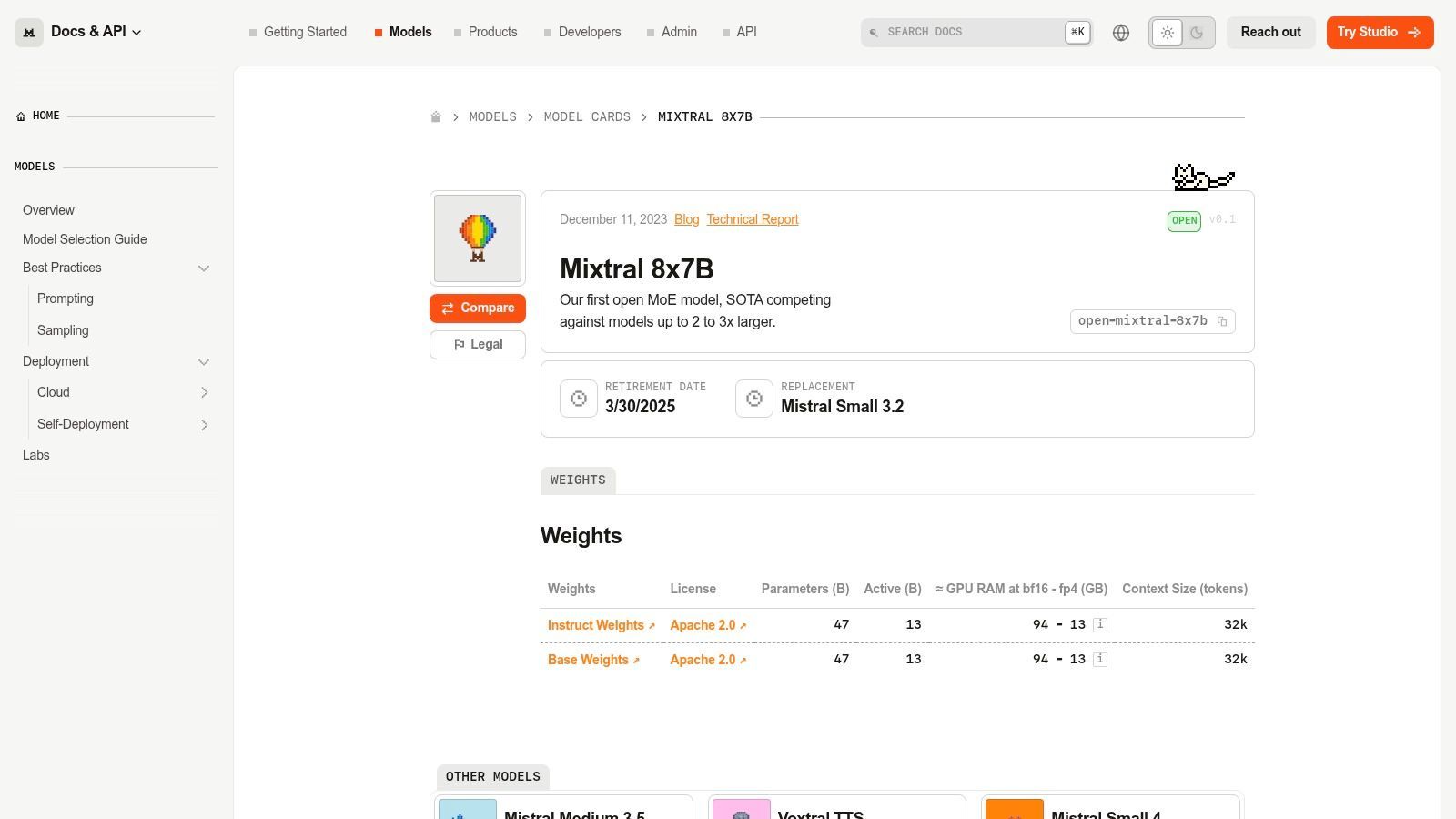
Mixtral 8x7B is what I reach for when a team wants better quality than a basic small dense model, but isn't ready to pay the operational bill for a flagship giant. The sparse MoE design is the whole point. You get stronger behavior than many smaller dense models without paying the full runtime cost of a uniformly active large model.
That makes Mixtral a practical middle layer in a multi-model setup. It can handle a lot of user-facing work before you need to escalate requests to something heavier.
Why Mixtral still matters
Mixtral sits in a sweet spot for production teams that care about cost-per-good-answer, not just leaderboard placement. It's commercially permissive under Apache 2.0, well supported, and good enough for many support, search-assistant, and document workflows. If your product has lots of medium-complexity queries, Mixtral often makes more sense than jumping straight to a 70B-class dense model.
Its strongest use is as a primary responder with fallback. Let the smaller cheap model handle boilerplate. Route medium-hard work to Mixtral. Send only the ugly edge cases higher.
- Best use case: Customer support agents, internal knowledge assistants, and general chat with moderate complexity.
- Why teams like it: Better quality than small dense baselines without committing the whole stack to top-end infra.
- Why legal likes it: Apache 2.0 removes a lot of friction.
The operational catch
MoE models can feel less predictable when you compare output style across runs and tasks. That's not a reason to avoid them. It is a reason to test with your actual prompts, retries, and guardrails instead of assuming uniform behavior from benchmark summaries.
The other catch is hardware planning. Mixtral is efficient for what it is, but it's not magically lightweight. Teams sometimes hear “fast for its quality class” and mistake that for “easy to run anywhere.” It isn't.
Mixtral is rarely the wrong choice when your product has outgrown 7B-class quality but your finance team still wants discipline.
3. Mistral 7B
Mistral 7B is the model I'd still hand to a startup that needs to self-host something useful this week. It's small enough to experiment with quickly, permissive enough for commercial work, and easy to adapt into a narrow, well-behaved component.
Many teams should prioritize this approach from the outset, even if they don't want to hear it. Early product teams often overbuy model quality and underinvest in evals, prompt control, and fallback logic.
The default small self-hosted model
A small dense model like Mistral 7B is valuable because it forces good system design. If your workflow can't produce acceptable output with a fast, cheap baseline, a larger model may hide the problem instead of solving it. Mistral 7B is especially good for structured transformations, light summarization, short-form chat, and domain-specific fine-tunes.
It's also easy to fit into local dev and lower-friction infra setups. That lowers the cost of iteration, which matters more than prestige in the first months of a product.
When not to force it
You shouldn't pretend Mistral 7B is a substitute for bigger models on harder reasoning or broad knowledge tasks. It isn't. When prompts become long, user intent gets messy, or multi-step decisions matter, you'll hit the ceiling quickly.
That's why I treat it as a baseline and a specialist. Not a universal answer.
- Use it for: First production deployments, narrow copilots, extraction pipelines, and cheap fallback capacity.
- Avoid it for: Complex coding help, difficult reasoning, and workflows that need broad contextual judgment.
- What works well: Fine-tuning it on a narrowly scoped task where consistency matters more than general intelligence.
A lot of “best open source llm” articles skip this point. Small models win when the task is constrained and the system around them is disciplined. They lose when teams ask them to impersonate general-purpose reasoning engines.
4. Qwen2.5 Qwen family

A common production failure looks like this. The team picks one model for everything, then spends the next three months writing exceptions around it. Chat works, coding is shaky, multilingual quality drops, and the “simple” stack turns into route-specific prompt hacks. The Qwen family is appealing because it gives you another option: build around a model family from the start, then route requests by cost, latency, and task difficulty.
That matters more than leaderboard placement. In production, the winning setup is often a small model for high-volume traffic, a larger model for escalation, and specialized variants for code or vision. Qwen fits that pattern well because the family spans multiple sizes and modalities without forcing you to rebuild your tooling every time requirements change.
Best for teams designing a router, not picking a mascot
Qwen is strongest when the product has mixed workloads. Support copilots that switch between English and Arabic. Internal tools that summarize documents, answer questions, and generate SQL. Developer assistants that need one path for general chat and another for code-heavy turns. A broad family gives you cleaner routing rules and fewer vendor-level migrations.
That is the main advantage here. You are not betting the whole product on one model's personality. You are setting up a portfolio.
The trade-off is operational discipline. A model family only helps if your prompts, evals, and fallback rules are standardized enough to swap variants without rewriting the application layer. If every model needs different prompt formatting, different safety handling, and different output parsing, the family becomes overhead instead of a benefit.
What to check before shipping Qwen
Licensing comes first. Qwen releases do not all carry the same usage terms, so teams need to verify the exact model card and license for the specific checkpoint they plan to deploy. Family reputation is not a legal review.
Then test for serving reality, not demo quality. Larger Qwen variants can look great in isolated prompting, but production behavior depends on context length, concurrency, quantization choices, and GPU memory pressure. I would rather see a slightly weaker model hold its latency target at peak load than a stronger one miss every SLO.
A unified backend changes the calculation here. If your inference layer can route short, cheap requests to smaller Qwen models and reserve larger ones for hard cases, the family becomes much more valuable. That is the production-focused reason to keep Qwen on the shortlist. It supports a practical multi-model strategy instead of forcing a single-model ideology.
For multilingual products, mixed task queues, and teams that expect requirements to shift, Qwen is one of the better foundations to build around.
5. Microsoft Phi-3
Microsoft Phi-3 is what I'd recommend when the product requirement is clear and glamorous benchmark chasing is a distraction. It's compact, commercially simple under MIT, and good for teams building on-device features, lightweight cloud endpoints, or cost-sensitive assistants.
For many products, that's enough. More than enough.
Small model first is often the right call
The strongest case for Phi-3 is economic discipline. If you're building guided workflows, short-turn assistants, or embedded features inside an existing app, a small model can clear the quality bar while keeping latency and operational complexity under control. You don't need a giant model to label support tickets, rewrite CRM notes, or provide contextual hints inside a workflow.
This also matches where a lot of underserved production advice is heading. Hugging Face's 2026 guide separates choices by use case such as general chat, coding, long-context RAG, multilingual, and on-device use, while BentoML's small-model coverage emphasizes that sub-1B and 3B models can be practical for lightweight multimodal and edge deployments in Hugging Face's open-source LLM guide. That's exactly the lens Phi-3 deserves.
Where Phi-3 stops being enough
The limit is straightforward. It won't replace much larger models on tasks that need broad world knowledge, deep synthesis, or complex reasoning over messy inputs. If your users ask open-ended questions with high ambiguity, Phi-3 will eventually show its size.
Still, small models are underrated because teams compare them to frontier models instead of comparing them to the actual job to be done.
- Strong fit: Mobile or edge scenarios, low-cost copilots, and embedded AI features.
- Weak fit: General research assistants, advanced coding agents, and hard reasoning.
- Big advantage: MIT licensing removes a lot of procurement and legal friction.
If the best open source llm for your app needs to be fast, cheap, and simple to ship, Phi-3 often beats more famous options.
6. Gemma 2
Gemma has become a serious option for teams that want a strong middle tier with solid backing and manageable size. Gemma 2, especially the larger end of the line, is attractive when 7B feels too small and 70B-class deployment feels too expensive or heavy.
Google's ecosystem support also helps. That doesn't make Gemma the best choice by default, but it does lower friction for teams already living around Google tooling.
Strong middle ground with one caveat
Gemma 2 is the kind of model I'd test for production chat, internal assistants, and summarization-heavy apps where quality matters but deployment realism still matters more. It occupies a practical lane many teams need.
The caveat is licensing language. Gemma's terms are not the same as a plain OSI-approved open-source license, and that distinction matters if your legal team cares about lock-in resistance and usage restrictions. A lot of buyers skip that step because the model feels “open enough.” Sometimes it is. Sometimes that assumption creates trouble later.
Why cost-sensitive teams still shortlist it
There's also a cost angle worth paying attention to. AIMultiple notes that chat-based applications account for 88 to 92 percent of the AI market, with ChatGPT plus Gemini representing about 84 percent of chat-category share in February 2026, and ChatGPT alone at roughly 60.5 percent of consumer web visits across tracked platforms in AIMultiple's LLM market share analysis. In that kind of market, serving economics matter as much as raw model quality.
The same analysis notes Gemma 3 27B as among the cheapest models at roughly $0.07 per million tokens. That's not a direct Gemma 2 benchmark, but it does illustrate the broader reason Gemma stays relevant. Throughput and cost trade-offs differ sharply across open models, and some teams care more about chat economics than absolute top-end capability.
If your app lives in high-frequency chat and budget pressure is real, Gemma deserves a serious eval pass.
7. StarCoder2

StarCoder2 is one of the few models on this list where specialization is the main reason to buy in. This is a code model first. If you're building an IDE assistant, repo helper, code search enhancement, or developer-facing generation workflow, that focus is useful.
If you're building a general assistant and hoping it will also do code well enough, I'd look elsewhere first.
Built for code not for everything
StarCoder2 benefits from being purpose-built around code tasks and a code-heavy ecosystem. Smaller sizes can make local or near-local developer assistance realistic, which changes the user experience in a good way. Developers care a lot about responsiveness. A code copilot that's slightly less brilliant but returns quickly often wins more trust than a slower one that occasionally produces a perfect answer.
There's also a bigger selection principle here. Task-specific benchmark leadership matters more than generic “overall best” labels. A code-heavy product should prioritize software-engineering style evaluations, not broad chat rankings.
What legal and product teams should flag
The downside isn't technical first. It's licensing. OpenRAIL-M includes use-case restrictions, so legal review isn't optional. If you're embedding code generation into a commercial developer product, that review needs to happen early.
You should also avoid using StarCoder2 as your default conversational model. It can be instructed to behave like a tech assistant, but that's not the same as being the strongest all-purpose chat model.
- Best fit: IDE copilots, code completion, repository analysis, engineering helpers.
- Poor fit: Broad consumer chat, nuanced general Q&A, mixed multimodal workloads.
- Main caution: Licensing review before commercial rollout.
The best open source llm for coding is usually not the best open source llm for everything else. StarCoder2 is a good reminder of that.
8. OLMo 2 Allen Institute for AI
OLMo matters because it answers a question most “open source LLM” lists avoid. How open is open, really?
For teams in research, regulated environments, or organizations that prioritize reproducibility, that question isn't academic. It changes what you can inspect, modify, and defend internally.
What real openness looks like
OLMo's appeal is the stack, not just the weights. The project emphasizes transparency across code, data, and evaluation. That's a different value proposition from a high-performing open-weight release with little visibility into the training pipeline.
If your team plans deep customization, serious model study, or high-trust internal review, OLMo is unusually compelling. It lowers ambiguity. It also gives researchers a cleaner base for experiments than many commercial-style releases.
“Open source” and “open weights” are not the same procurement decision.
Why most startups still won't choose it first
The trade-off is polish and convenience. Startups shipping user-facing features usually need instruction quality, easy deployment, strong community recipes, and less hands-on tuning. Commercially oriented model families often win there.
That doesn't make OLMo a niche curiosity. It makes it a tool for a different buyer.
A practical gap in current coverage is deployment realism. Many roundups optimize for benchmark leadership but don't tell teams which model is best once hardware, context, and operational constraints enter the picture. Taskade's 2026 coverage also points to another neglected issue, whether “open source” really means easy-to-run open weights with strong resistance to vendor lock-in, and how hidden serving costs shape the practical choice in Taskade's discussion of open-source LLM trade-offs. OLMo belongs in that conversation more than in a generic top-ten popularity contest.
9. MPT-7B MosaicML and Databricks
MPT-7B is an older pick, but older doesn't mean useless. In enterprise environments, “boring and documented” is often a feature. MPT earned trust early because it was commercially usable, understandable, and stable enough to fine-tune and deploy without much drama.
That history still matters if you're supporting legacy systems or inheriting previous model choices.
Still useful when boring is good
MPT-7B remains serviceable as a baseline, especially in organizations that already built tooling around it. If your team needs a mature Apache 2.0 model with known behavior and predictable deployment patterns, MPT can still be the practical answer.
I also like it as a comparison point. If a new candidate doesn't clearly beat your MPT-based baseline in your own evals, switching may not be worth the migration cost.
Why it has mostly become a legacy baseline
The obvious downside is capability drift. Newer 7B-class models such as Mistral 7B and compact newer families usually offer better quality or better efficiency. Community momentum has moved too. That means fewer fresh recipes, fewer active experiments, and less upside from following the ecosystem.
So I wouldn't choose MPT-7B for a greenfield product unless there's a very specific reason. I would absolutely keep it in mind for enterprises that value stability over novelty.
- Good choice for: Existing enterprise stacks, baseline comparisons, conservative deployments.
- Bad choice for: Teams chasing best-in-class current quality.
- Real value: Predictability and mature documentation.
Not every best open source llm decision is about the newest release. Sometimes the best decision is avoiding a migration you don't need.
10. Falcon 180B
A team picks Falcon 180B because they want the strongest possible open-weight model in-house. Then the significant work starts. GPU planning, tensor parallelism, long warm-up times, and a serving bill that forces hard questions about whether every request belongs on the biggest model you can run.
That is why Falcon 180B matters less as a default recommendation and more as a lesson in production strategy.
Falcon was an important release. It showed that open-weight models could compete at a scale that used to feel reserved for closed providers. That made it influential. It also made its trade-offs impossible to ignore.
Where Falcon 180B still makes sense
Falcon 180B fits teams with a specific requirement set: large internal infrastructure, tolerance for operational complexity, and a reason to keep inference under their own control. Research groups, regulated enterprises, and platform teams building premium high-context or high-difficulty routing tiers can still justify it.
In those cases, the model is not the whole decision. The deployment pattern is. A large model like this works best as the top tier in a routed stack, not as the only engine behind every feature.
Why it rarely wins a fresh production bake-off
The problem is not only raw compute cost. It is everything around it. Capacity planning gets harder, latency becomes more variable, and failure modes become more expensive because each bad routing decision sends an easy task to your most resource-hungry model.
Licensing also needs a closer read than many teams expect. If your legal team prefers permissive terms such as Apache 2.0, Falcon may create more review overhead than newer alternatives.
That changes the recommendation. For a greenfield product, the better path is usually to set a quality bar, choose a smaller model that clears it for common requests, and reserve a giant model for narrow cases where it earns its keep.
Falcon 180B still deserves a place on this list because it marked a turning point for open-weight LLMs. In practice, though, it is now more useful as a selective escalation model, or as a benchmark for what your infrastructure can tolerate, than as the center of a modern stack. The broader lesson is the one that matters for production teams: model selection is only step one. The key advantage comes from managing multiple models behind one backend and routing requests based on cost, latency, and task difficulty.
Top 10 Open-Source LLMs Comparison
Your Next Step From Model Selection to MVP
The best open source llm isn't the one with the loudest launch cycle. It's the one that fits your product's actual constraints. That means user experience first, then infra, then licensing, then benchmark depth in the exact tasks your product needs. Reversing that order, however, often leads to future costs.
The pattern I trust most is still simple. Start with the smallest model that can pass a serious evaluation set for your task. For many teams, that means beginning with something like Phi-3 or Mistral 7B for narrow workflows, internal tooling, or early user-facing features. Small models are cheaper to test, easier to host, easier to swap, and much more forgiving when the rest of the system is still changing.
Once you have real traffic and real failure cases, add a second tier. In this tier, models like Mixtral, Qwen, Gemma, or Llama become useful as selective upgrades rather than universal defaults. You don't need your highest-cost model answering every easy question. You need routing that knows when the cheap path is enough and when the better model is worth it.
That routing layer is where a lot of teams either become efficient or get stuck. If prompt logic, provider settings, failovers, observability, and model-specific parameters all live in application code, every model decision turns into a redeploy. That's manageable for a demo. It becomes painful once product, ML, and ops all need to move at the same time.
A better production setup separates the app from the model control plane. Prompts should be versioned. Fallbacks should be configurable. Logs should show latency, token usage, and output behavior per call. Switching from a small baseline to a stronger model should feel like an operational change, not a rewrite.
This matters even more because the open-model market is now shaped by deployment realities, not just research excitement. Public discussion has shifted toward throughput, latency, context length, and task-specific leadership. Teams also need to think about what “open” means in practice. Some models are permissively licensed and easy to run. Others are open-weight releases with restrictions or hidden serving costs. Some are excellent in code. Others are stronger in multilingual work, reasoning, or chat economics. If you choose once and hardcode everything around that choice, you're building brittleness into the product.
The durable strategy is a multi-model one. Use a compact model for the bulk of low-risk requests. Route harder prompts to a stronger general-purpose model. Keep a specialist for code, multilingual, or long-context tasks if your product needs them. Monitor failure modes. Re-run evals when a new contender appears. Treat model selection as an operating discipline, not a one-time purchase.
That's also the cleanest way to future-proof your stack. The frontier will keep moving. New open models will arrive. Some will beat your current favorite on quality, some on cost, some on speed, and some on legal simplicity. If your backend can absorb those changes without forcing app rewrites, you'll keep shipping while everyone else is debating benchmark screenshots.
If you want that flexibility without hardcoding your entire AI layer, Supagen is a practical way to run it. You can manage prompts, route across models and providers, add fallbacks, inspect logs for latency and token usage, and change behavior without redeploying your app. For teams building AI features fast, that's often the difference between a clever prototype and a system you can operate.