
AI Chatbot Development: A Production-Ready Guide for 2026
Most advice on ai chatbot development still treats the hard part as getting a bot to answer once. That's the wrong benchmark. The work starts after launch, when users pile on edge cases, costs drift upward, retrieval gets noisy, and the bot has to behave like a service, not a demo.
That shift is already baked into the market. The global AI chatbot market was estimated at $7.76 billion in 2024 and projected to reach $27.29 billion by 2030, which implies roughly 23.3% annual growth over that period (market estimate and forecast). Another market snapshot put the category at $4.92 billion in 2023, showing how quickly the space expanded in just one year (same market context). That kind of growth changes the engineering bar. Teams aren't shipping clever scripts anymore, they're building production systems with routing, observability, fallback behavior, and cost control.
Table of Contents
- Moving Beyond the 'Hello World' Chatbot
- Strategic Planning for Production AI
- The Core Engine of Models Prompts and Routing
- Effective Observability and Cost Control
- Ensuring Quality with Rigorous Testing and Safety
- Deployment Patterns and Common Pitfalls to Avoid
Moving Beyond the 'Hello World' Chatbot
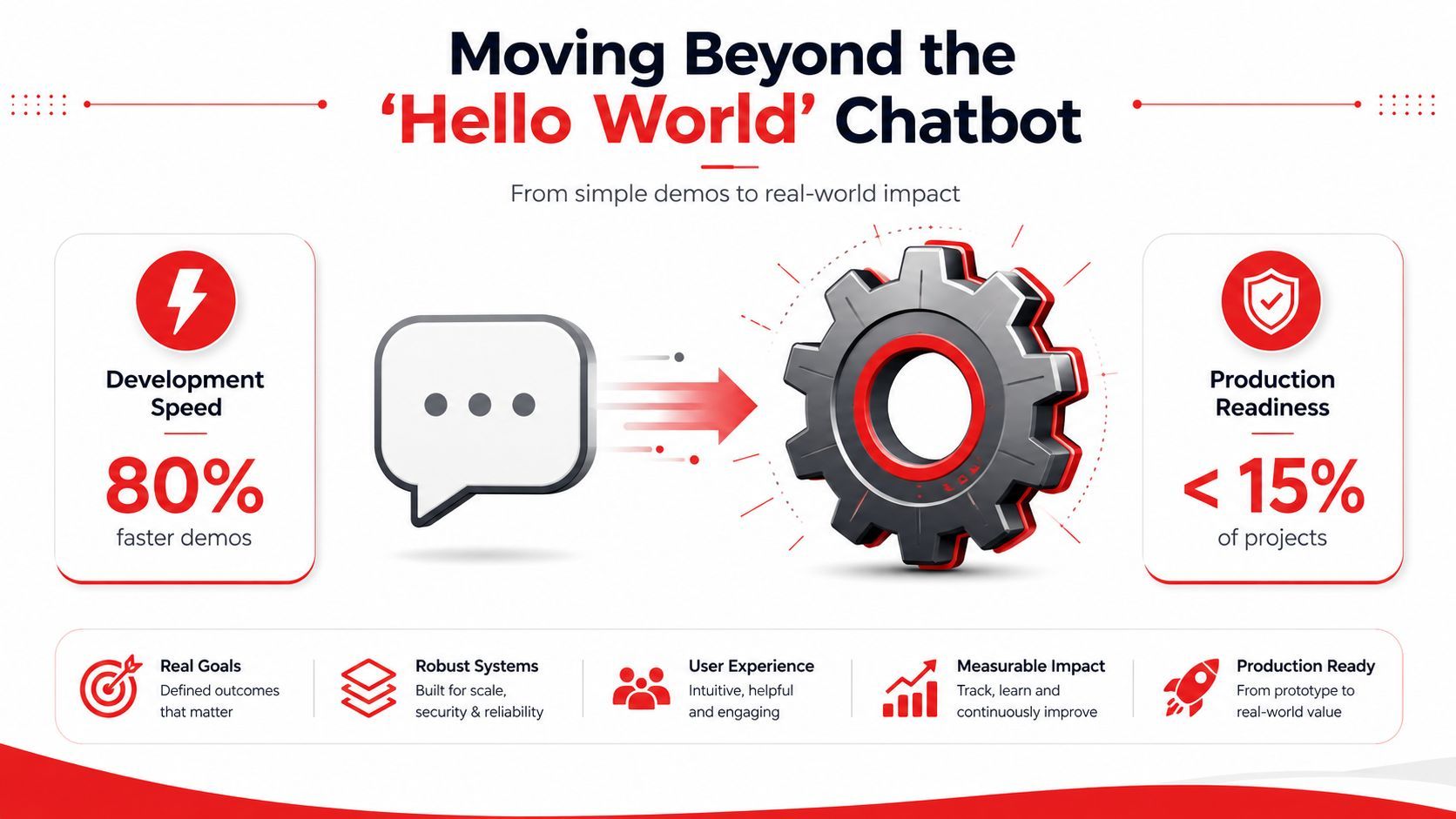
The easiest chatbot to build is the one that never meets a real user. A polished demo can answer a few canned questions, but production traffic exposes everything the prototype hid, from brittle prompts to weak retrieval and slow fallbacks. The difference between a weekend build and a real service is less about model choice and more about whether the system keeps working when the inputs stop being polite.
The demo trap
A demo optimizes for first impression. Production optimizes for repeatability. That difference matters because this category has moved from experimentation into mainstream software infrastructure, with deployment decisions now affecting support, sales, and internal workflows at scale (market overview).
The old assumption was that chatbot development was mostly a front-end conversation problem. The hard parts sit behind the interface. Teams need versioned prompts, routing rules, observability, and a way to update behavior without shipping a full redeploy every time a message breaks.
Practical rule: if you can't explain how the bot behaves when retrieval fails or the model returns nonsense, you don't have a production system yet.
A unified backend changes the game
Hardcoding AI behavior directly into application code slows every change. It also makes rollback painful, because a prompt tweak or model swap becomes a deployment event instead of a configuration update. A unified AI backend gives product and engineering teams one place to manage prompt versions, route requests, and inspect what happened on each call.
That architecture matters most once usage grows beyond the pilot stage. Production chatbots need a control plane, not just a UI and an API key. They also need to support experimentation without forcing the whole stack through the same release process every time a conversation drifts.
The core mindset shift is simple. Build the bot like a service with operating rules, not like a script with a chat window. Once that clicks, the rest of the work becomes much more disciplined.
Strategic Planning for Production AI
Good chatbot projects do not start with the model. They start with a narrow set of business problems that are worth automating and safe enough to test in production. The strongest rollout pattern is to pick 3 to 5 high-volume, low-complexity use cases, define business and technical KPIs before launch, and reserve 20 to 30% of first-year implementation cost for maintenance and continuous improvement (implementation guidance).
Pick the right first use cases
Do not start by asking what the bot can do. Start by asking where the team spends time answering the same questions, where the answer is already known, and where a bad response will not create unnecessary risk. That approach usually produces the fastest early wins because the workflow is repetitive, the knowledge base is stable, and success is easy to measure.
The point of that filter is focus. A chatbot that tries to solve everything usually becomes a weak assistant for everything. A chatbot that handles a few bounded jobs well can earn trust, reduce handoff pressure, and create a clean path to broader automation later.
Define success before launch
A lot of teams wait until after launch to decide what “good” means. That's a mistake. For production AI, success needs to be explicit up front, because the system will always produce some mix of correct answers, deferrals, and mistakes. If you do not define acceptable behavior early, every stakeholder ends up judging the bot by a different standard.
The same rollout guidance suggests first-90-day benchmarks of 40 to 60% containment rate, CSAT within 10% of human-agent scores, and a fallback rate below 20%. Those targets are useful because they force the team to think in operations terms, not vanity metrics. Containment alone is not enough if the bot is confidently wrong. CSAT alone is not enough if the bot only succeeds on trivial questions.
Plan for escalation, not just automation
Human handoff should be designed, not patched in later. If the bot cannot answer with enough confidence, it needs a clean path to an agent, a ticket, or a deterministic workflow. That handoff should preserve the conversation context and make it obvious what failed, because the handoff itself becomes part of the product.
The strongest teams treat escalation as a quality signal. If the bot escalates too often, the knowledge base may be incomplete. If it escalates too rarely, the confidence threshold is probably too loose. Both problems are fixable, but only if the team is measuring them from day one.
The Core Engine of Models Prompts and Routing
A production chatbot falls apart fast when prompts and model selection live inside scattered application files. That approach works until the first serious iteration cycle, then every change becomes a code change, every test needs a redeploy, and every rollback takes longer than it should. Decoupling model logic from application logic is not a nice-to-have, it's the difference between a living product and a fragile integration.
Treat prompts as versioned assets
Prompts should be managed like product assets, not buried inside handlers. Once they're versioned, teams can compare behavior across revisions, roll back regressions, and test changes without rewriting the application. That matters because prompt tuning is never really finished. It's an ongoing process of refining intent, reducing ambiguity, and making outputs more predictable.
When prompts stay in code, the whole organization pays for each edit. Engineers get pulled into changes that product could have validated in a dashboard, and simple text tweaks start competing with feature work. A dedicated control layer cuts that overhead.
Route models intentionally
Not every request deserves the same model. Some calls need a fast, economical path. Others need a stronger reasoning model or a multimodal provider. Routing is where production chatbot systems become smarter than a single-model wrapper, because the application can decide which provider fits the job instead of forcing every request through the same expensive path.
That routing layer also creates resilience. If one provider slows down or fails, the system can fall back without user-visible downtime. If the request is simple, the system can avoid overpaying for a model that's too large for the task. Good routing isn't about cleverness, it's about making the cheap path safe and the expensive path deliberate.
A production chatbot should fail over in a way the user barely notices. If every provider issue turns into a visible outage, routing hasn't been implemented as infrastructure.
Keep the application thin
The app should ask for AI behavior, not contain it. That means the product code sends the request, the backend decides how to route it, and the dashboard or control plane holds the changing parts. This separation makes it possible to test prompt variants, change providers, and adjust fallbacks without a fresh deploy for every experiment.
It also improves team velocity. Product can tune behavior, engineering can focus on integration and reliability, and ops can inspect the system without reading every code path. Once a chatbot reaches production, that separation stops being architectural preference and starts becoming basic hygiene.
Effective Observability and Cost Control
Most chatbot teams only notice cost problems after the bill shows up. By then, the model has already burned budget, and the team is guessing about which prompt, route, or fallback caused it. Production AI needs per-call visibility into tokens, latency, inputs, outputs, and the exact cost of each interaction, because without that data you cannot tell whether the system is efficient, overbuilt, or slowly getting worse.
What traditional logging misses
Standard app logs tell you a request happened. They do not tell you whether the model call was expensive, which prompt version was used, how long the provider took, or whether the output triggered a fallback. That gap is why AI observability has to be more granular than ordinary server logging.
The operational question is not just “did it work?” It is “what did it cost, how long did it take, and what should change next time?” If a team can answer those three questions for every call, debugging gets faster and routing decisions get sharper. If it cannot, the chatbot becomes a black box with a usage bill.
Use the data to steer model choice
Cost control is really decision control. Once you can see per-call spend and latency, model selection stops being a guess and becomes a trade-off you can measure. You can reserve expensive models for hard problems, push simple requests to lighter options, and spot when a fallback is doing too much work.
That visibility matters even more as usage grows. The broader AI field has attracted major investment, including $67.2 billion in U.S. private AI investment in 2023 according to Stanford's 2024 AI Index, which makes operating efficiency a real budget issue rather than a side concern (Stanford AI Index context). As AI workloads become a larger line item, teams need to know where spend is coming from and how to trim it without damaging quality.
Watch the right operating signals
The most useful metrics are the ones that change behavior. Latency shows when the user experience is slipping. Token usage shows when prompts are bloated. Cost per call shows whether the current routing strategy is sustainable. Together, those numbers show whether the chatbot is healthy or drifting.
A good dashboard turns those signals into action. If a prompt revision adds cost with no improvement in answer quality, roll it back. If a certain class of requests keeps hitting a slow provider, route them elsewhere. If multimodal calls are inflating spend without clear value, narrow where they are allowed. That is what production-grade AI operations look like.
Ensuring Quality with Rigorous Testing and Safety
Basic accuracy tests don't tell you whether a chatbot is trustworthy. A bot can sound fluent, pull the wrong source, or confidently answer outside its knowledge base, and a simple pass or fail score won't show the difference. Production quality needs a workflow that checks retrieval, grounding, fallback behavior, and escalation logic under realistic conditions.
Test against the knowledge base, not vibes
The most practical validation step is to test the top 20 to 100 expected queries against the approved knowledge base and measure whether the system can ground its answers correctly (validation guidance). One useful acceptance rule is whether the top three retrieved chunks contain the correct answer for at least 80% of those queries. If they do not, the guide recommends using a hybrid BM25 retriever or a cross-encoder reranker to improve retrieval quality.
That check matters because it surfaces retrieval problems before the model even speaks. If the wrong content gets pulled into context, the generator starts from a bad place. Testing retrieval first saves a lot of false blame later, especially when the answer looks polished but the source material is off.
A separate validation pass should check whether the system stays inside the approved scope. Teams often find that a chatbot can answer routine questions well, then drift on edge cases where the knowledge base is thin or conflicting. That is the point where you need a test set built from real user intents, not a hand-wavy sample chosen to make the demo look good.
Measure more than correctness
For RAG systems, the useful metrics are faithfulness, answer relevance, and context recall (validation guidance). Faithfulness checks whether the answer stays anchored to the retrieved material. Answer relevance checks whether the response addresses the question. Context recall checks whether retrieval surfaced the information that mattered.
Those metrics matter because a chatbot can fail in different ways. It can retrieve the right source and still paraphrase badly. It can answer smoothly while inventing unsupported details. It can retrieve too little context and force the generator to guess. A production team needs to know which failure mode it is seeing, not just that the output looked off.
A useful test harness compares these signals side by side. If faithfulness drops while answer relevance stays high, the model may be overconfident. If context recall is weak, the index or retriever needs work before prompt tuning will help. If all three look fine in offline tests but users still complain, the failure may be in routing, prompt leakage, or a knowledge base that is stale in the places that matter.
Practical rule: if you can't separate retrieval failure from generation failure, you won't know whether to fix the index, the prompt, or the model.
Set confidence thresholds for escalation
Escalation should happen because the system is uncertain, not because the team wants to hide mistakes. That means defining confidence thresholds, testing them against real traffic, and checking whether human handoff improves resolution quality. If escalation only masks model errors, it is a bandage. If it improves outcomes, it belongs in the product.
Teams also need a clear policy for what the bot should do when it lacks enough evidence. A good fallback can ask a clarifying question, route the user to a human, or refuse to answer and explain why. The wrong fallback is one that guesses under pressure, because that creates a support burden later and makes the chatbot harder to trust.
AI governance context pushes teams toward that kind of discipline. NIST's AI Risk Management Framework emphasizes validity, reliability, and monitoring as trustworthiness attributes. The point is not to make the bot perfect. It is to prove when it is reliable enough to answer and honest enough to step aside.
Deployment Patterns and Common Pitfalls to Avoid
Deployment is where chatbot projects either become durable or become expensive experiments. The best pattern depends on the team, but the principle stays the same, keep the AI layer separable, inspectable, and easy to update. Whether the service runs in serverless functions or containers, the chatbot should connect cleanly to the AI backend through a simple integration surface instead of embedding model behavior all over the codebase.
Favor simple integration over tight coupling
A thin application layer makes deployment easier because the AI logic lives elsewhere. That gives teams flexibility to move between environments, change providers, or update prompt behavior without rewriting core product code. It also keeps the app easier to reason about when something breaks, because the place to debug is obvious.
Containerized services work well when the chatbot has heavier integration needs or more custom runtime behavior. Serverless functions work well when the workflow is lighter and the request pattern is cleaner. The right choice depends on the surrounding product, but both approaches benefit from the same principle, keep the model logic out of the application body.
Avoid the classic production failures
The failures are usually familiar. Hardcoded prompts slow iteration. Weak observability hides cost spikes. Inadequate testing lets hallucinations leak into the user experience. Missing fallback behavior turns provider hiccups into outages. Each problem is manageable on its own, but together they create a chatbot that feels clever in development and unreliable in production.
The fix is less glamorous than most AI tutorials suggest. Centralize prompt changes. Measure every call. Test against the knowledge base. Route intelligently. Escalate cleanly. That combination gives the team a service it can operate.
Make the control plane the source of truth
Production AI gets easier when one system owns routing, prompt versions, logs, and usage data. That's what keeps changes auditable and lets teams move quickly without losing visibility. It also helps non-engineers participate in iteration safely, because not every adjustment needs a code push.
The long-term pattern is straightforward. Keep deployment deterministic, keep AI behavior configurable, and keep the operational data in one place. That's how chatbot projects stop feeling like fragile demos and start behaving like infrastructure.
If you're building an AI chatbot that needs to survive real traffic, use Supagen to keep prompts, routing, observability, and cost tracking in one production layer. Visit Supagen to see how a unified AI backend can make your chatbot easier to ship, easier to operate, and much harder to break.